
By Joe Pasma, PE | PGS Consulting LLC, Licensed Professional Engineer | 40+ Years in SIP Engineering, Manufacturing, and Forensic Analysis | Published April 7, 2026 | Updated October 19, 2026
Structural Insulated Panels (SIPs) are often described as simple. Foam and skins.
But in real projects, they are anything but simple.
Performance depends on how the core, facings, adhesive, and code pathway work together. When those pieces align, SIPs deliver strong structural performance and energy efficiency. When they don’t, problems tend to show up quickly.
This guide breaks down SIP core types, SIP panel materials, adhesives, and system considerations so builders, architects, and manufacturers can make informed decisions.
Who This Guide Is For
Builders evaluating SIP systems
Architects and designers designing high-performance envelopes
Manufacturers refining production and QA
Owners comparing building systems
Key Takeaways
SIPs are a composite building material, not just foam and skins
EPS is the most common and stable SIP core
GPS improves thermal performance by reducing radiant heat transfer
PUR/PIR offer higher R-values but include thermal drift and higher cost
OSB is the most widely used structural facing
Facing materials impact structure, fire resistance, and durability
Adhesive type matters tremendously
SIP performance depends on system alignment, not individual materials
In simple terms:
SIP performance is not about one material. It is about how the core, facings, and adhesive work together as a composite.
What Are Structural Insulated Panels (SIPs)?
Structural Insulated Panels (SIPs) are high-performance building panels made of an insulation core bonded between two structural facings, typically OSB. SIPs function as both structure and insulation, creating a strong, energy-efficient building envelope.
As the name states, SIPs are structural. This means the panels don’t just enclose a building — they actually support loads. The reason they can do this is the stiff, thick facings (typically OSB, MgO, or other engineered skins) bonded to the insulation core. These skins do not buckle locally when axial loads are applied, which allows the panel to carry gravity loads such as snow, people, and the everyday weight of the building. Working together with the foam core as a composite member, SIPs also resist wind and other transverse forces, and provide in‑plane strength that helps the building stand up to racking and lateral movement. In wall assemblies, SIPs can function as shear walls, and in floors and roofs they act as diaphragms that transfer loads across the structure.
This structural behavior is very different from thin‑skin metal “cooler panels,” which may look similar but are not structural. Cooler panels use very thin metal facings that buckle easily under axial load, meaning they can only handle transverse pressure inside refrigerated spaces. Because these skins cannot resist compression or shear, cooler panels cannot carry axial loads, cannot resist racking, and cannot function as shear walls or diaphragms in a building. They are enclosure products only — not load‑bearing components.
What Are the Main Types of SIP Core Materials?
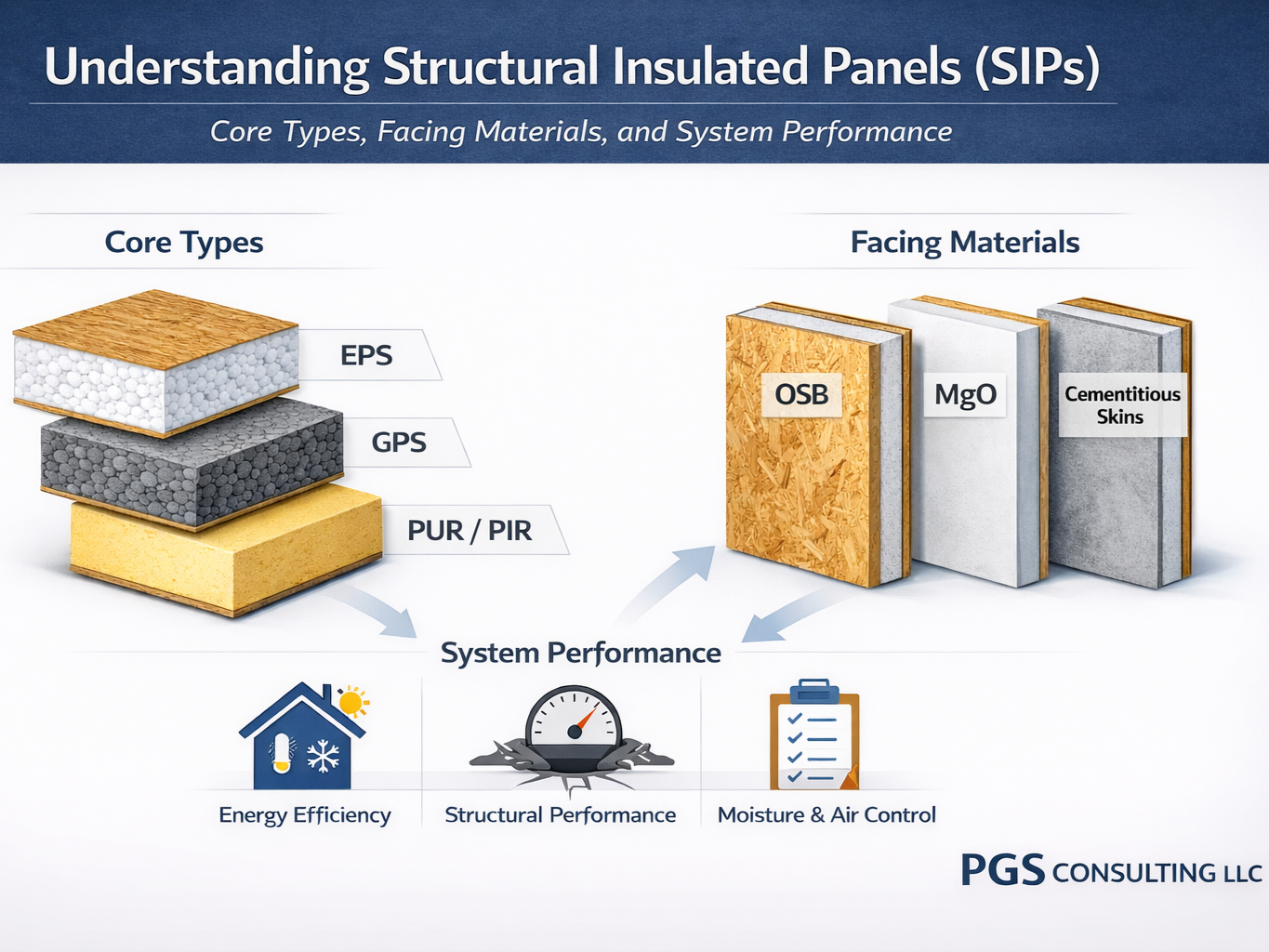
The three primary SIP core materials are EPS (expanded polystyrene), GPS (graphite polystyrene), and PUR/PIR (polyurethane-based foam). Each core type differs in thermal performance, cost, long-term stability, and manufacturing complexity.
EPS (Expanded Polystyrene): The most widely used SIP core, known for stability, predictability, and cost efficiency
GPS (Graphite Polystyrene): An enhanced version of EPS with higher R-value and improved thermal performance
PUR/PIR (Polyurethane-based cores): Higher R-value per inch with more complex manufacturing and long-term performance considerations
Which SIP Core Has the Best R-Value?
PUR/PIR SIP cores have the highest initial R-value, typically between R-6.5 and R-7.2 per inch. However, EPS and GPS provide more stable long-term R-values because they do not experience thermal drift.
What Is the Best SIP Core Type?
There is no single best SIP core type. EPS is the most widely used and stable, GPS offers improved thermal performance, and PUR/PIR provides higher R-value per inch with additional cost and complexity. The right choice depends on project goals and system requirements.
SIP Core Types Comparison
The table below compares the main SIP core types based on thermal performance, stability, moisture behavior, manufacturing implications, and typical applications. On mobile, swipe left to view the full table.
| Core Type | R-Value | Stability | Moisture Behavior | Manufacturing / Adhesion | Cost | Best Use | Key Tradeoffs |
|---|---|---|---|---|---|---|---|
| EPS |
* R-3.6 to R-4.2/in * Stable over time |
* Predictable long-term behavior * Well-supported by engineering tables |
* Slow vapor diffusion * Does not move liquid water laterally * Requires proper sealing at joints |
* Bonds very well to OSB * Forgiving during lamination * Strong manufacturing consistency |
$ |
* Both Residential & commercial envelopes * Large-format panels * Cold climates |
* Lower R-value per inch * Most proven and code-supported option |
| GPS |
* R-4.7 to R-5.1/in * Higher thermal performance than EPS |
* Stable like EPS * No thermal drift |
* Similar to EPS * Slow, predictable diffusion * Good dimensional stability |
* Bonds very well to OSB * Uses same adhesives and equipment * Easy upgrade from EPS production |
$$ |
* Higher-performance envelopes * Energy-focused projects * Cold climates |
* More limited availability * Slightly higher cost than EPS |
| PUR / PIR |
* Initial: R-6.5 to R-7.2/in * Aged: R-5.0 to R-6.5/in |
* Higher initial performance * Long-term thermal drift must be considered |
* Less vapor permeable * Moisture behavior depends on assembly design |
* More complex chemistry * Tighter manufacturing control required * Different processing behavior than EPS/GPS |
$$$$ |
* Thin wall assemblies * Commercial applications * High-performance projects |
* Higher cost * Thermal drift over time * More complex production |
Each SIP core type should be evaluated as part of the full building system, not as a standalone material decision.
Looking for specific manufacturers that produce these SIP systems?
Explore the list of SIP manufacturers in both North America and Internationally→
EPS SIP Panels: The Industry Standard
EPS (expanded polystyrene) is the most widely used SIP core in North America. It is reliable, predictable, and well-supported by building codes.
Why EPS Works Well
Stable R-value over time
Strong adhesion to OSB
Predictable structural behavior
Performs well in cold climates
Best Use Cases
Residential construction
Commercial construction
Large-format panels
Cost-sensitive projects
GPS SIP Panels: Higher Performance Without Changing the System
GPS is a modified version of EPS that includes graphite to improve thermal performance.
Key Advantages
10 to 20 percent higher R-value than EPS
Same structural and installation behavior
Improved energy performance without changing system design
Best Use Cases
Higher performance buildings
Projects targeting higher insulation performance
PUR/PIR SIP Panels: High Performance With Tradeoffs
PUR and PIR SIP cores provide higher R-values but introduce additional considerations.
Key Considerations
Higher initial R-value
Thermal drift over time
Higher cost
More complex manufacturing requirements
Roof spans maybe limited due to panel thickness limitations
Best Use Cases
Thin wall assemblies
Commercial or high-performance applications
What Are SIP Facing Materials?
SIP facing materials provide the structural strength of the panel and play a major role in durability, fire performance, and long-term behavior.
OSB (Oriented Strand Board): The most common facing, offering strong structural performance and large panel sizes
MgO (Magnesium Oxide Board): A non-combustible option used in fire-resistant and specialty applications
Cementitious Skins: Durable, non-combustible facings used in high-demand or specialty environments
The table below compares common SIP facing materials based on structural performance, fire characteristics, moisture behavior, and typical applications. On mobile, swipe left to view the full table.
| Facing Material | Structural Performance | Fire / Heat Behavior | Moisture Behavior | Panel Size | Best Use | Key Tradeoffs |
|---|---|---|---|---|---|---|
| OSB |
* Excellent shear strength * Strong diaphragm performance * Enables large structural panels |
* Combustible * Requires code-compliant thermal barriers * Well understood in building codes |
* Performs well when properly detailed * Sensitive to prolonged exposure during construction * Requires weather protection |
* Large format panels * Often up to 8 × 24 ft |
* Most residential and commercial SIPs * Roof, wall, and floor systems * Large-scale panelized construction |
* Requires proper moisture management * Not fire-resistant without protection |
| MgO |
* Good structural performance * Varies significantly by manufacturer * Requires verification of testing |
* Non-combustible surface * Transfers heat to the core * Fire performance depends on full assembly |
* Moisture resistant * Can contain chlorides * Potential corrosion risk if poorly manufactured |
* Typically smaller panels than OSB * More limited large-format availability |
* Fire-resistant assemblies * Specialty commercial applications * Projects with specific durability needs |
* Quality varies widely * Requires careful sourcing and evaluation |
| Cementitious |
* Strong in compression * More brittle in flexure * Less forgiving than OSB systems |
* Non-combustible * Heat still transfers to the core * Assembly design is critical |
* Highly durable * Resistant to moisture and impact * Performs well in harsh environments |
* Smaller panels * Typically 4 × 8 or 4 × 10 |
* High-durability applications * Fire-critical environments * Specialty construction |
* Heavier panels * More labor-intensive installation * More seams and connections |
Facing materials should always be evaluated as part of the full SIP system, not as a standalone material choice. Structural performance, fire behavior, and durability are influenced by how the facing, core, adhesive, and assembly details work together.
Although insulated metal panels (IMPs) may look similar to SIPs, they are not structural panels. As the Metal Construction Association notes, IMPs perform very well under transverse loading such as wind or snow, but their thin metal facings buckle easily under axial compression and provide low resistance to racking loads. Because of this, cooler‑type IMPs cannot function as load‑bearing walls, shear walls, or diaphragms. They are excellent enclosure products, but they are not designed to carry building structural loads. (See MCA Technical Bulletin: Insulated Metal Panels – Structural Loading.)
Why Are Adhesives Critical in SIP Systems?
Adhesives are what allow Structural Insulated Panels to function as a single composite structural unit.
Without a reliable bond between the insulation core and the facings, the panel cannot transfer loads effectively. In that case, it is no longer acting as a composite structural unit.
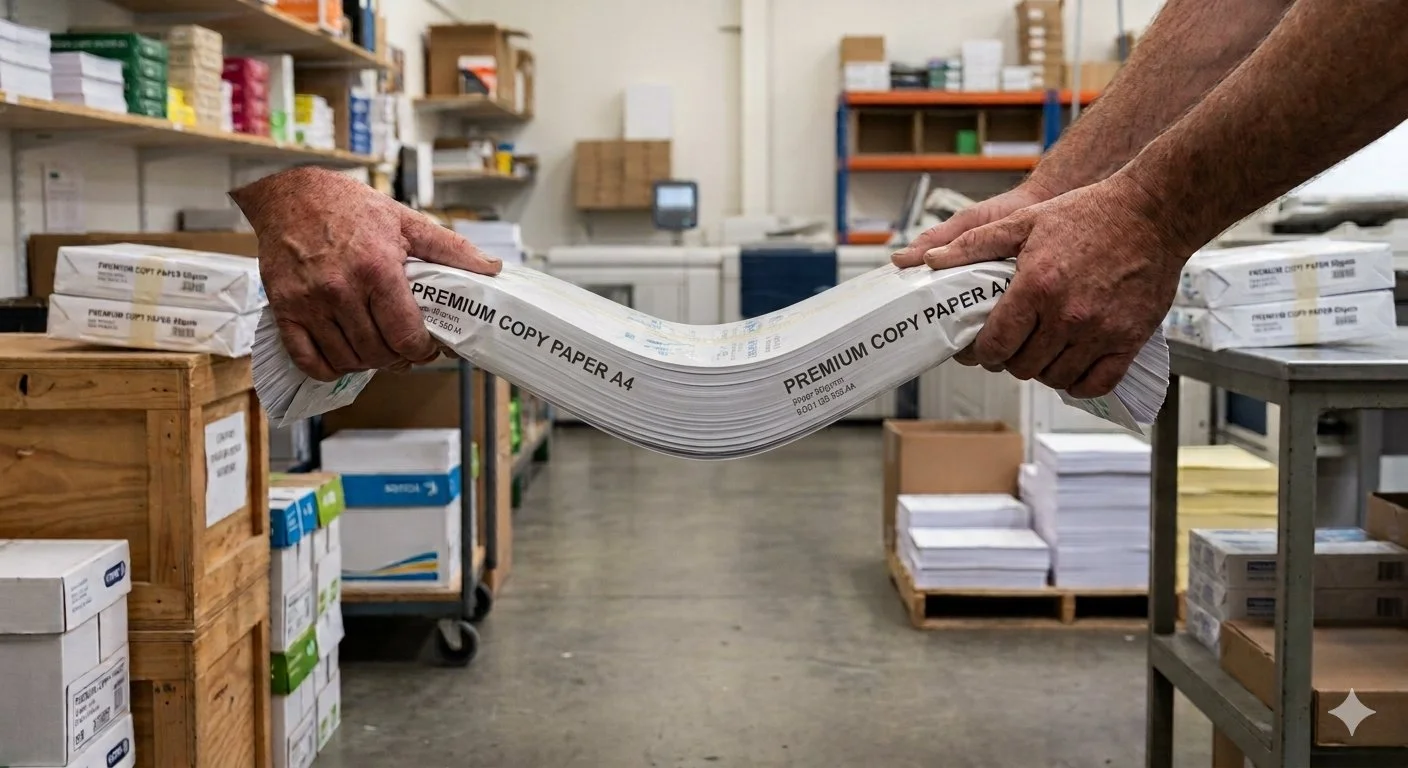
Picture a SIP panel as a ream of copy paper with a plastic wrapper on top and bottom of the ream. The two OSB skins on the outside of the SIP act like the plastic wrapper of the ream of paper when the ream is bent. They stretch and compress as the panel (ream) bends under load. The bottom stretches and the top compresses. The foam core in the middle (the sheets of paper) does a different job: it resists shear, which is the sliding force between the top and bottom skins. The two only work well together because they're glued into one solid unit. That teamwork is called composite action, and it's the reason a panel just a few inches thick can be so stiff for how little it weighs. It's also why the foam core's own flexibility matters more in a SIP than it would in a solid wood beam or an engineered I-joist.

Adhesives: Performance Characteristics
Polyurethane Adhesives
Polyurethane (PU) adhesives are the backbone of modern SIP manufacturing in the U.S. They provide robust, flexible bonds between facers and foam cores, are available in one- and two-part formulations, and are favored for their chemical and moisture resistance. To date, only Bostik and DuPont are listed as component material sources for the SIPA ESR-4689 Evaluation Report.
Application Methods
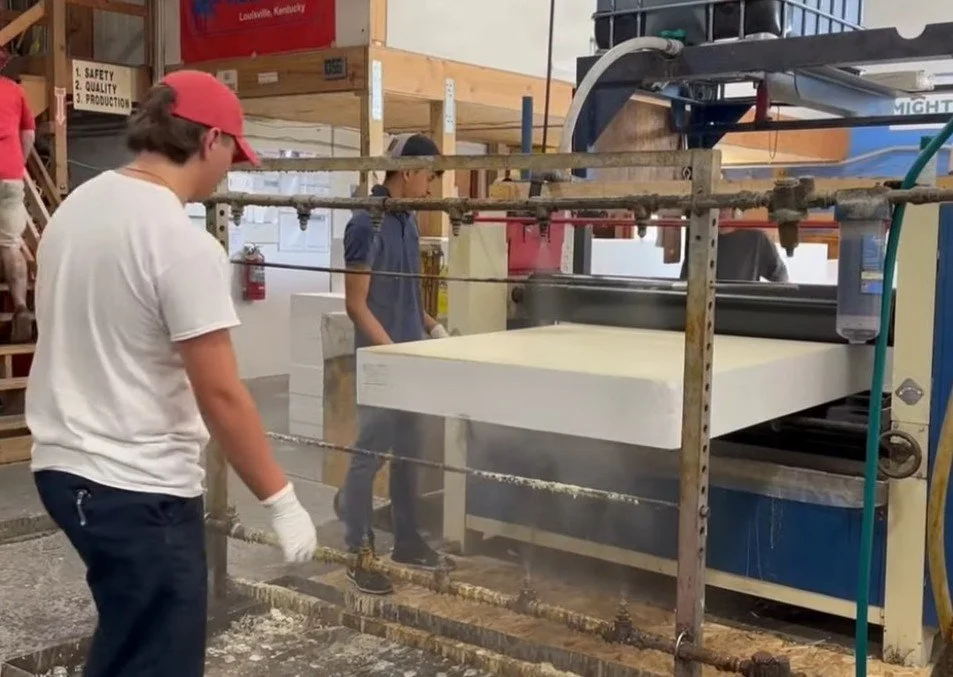
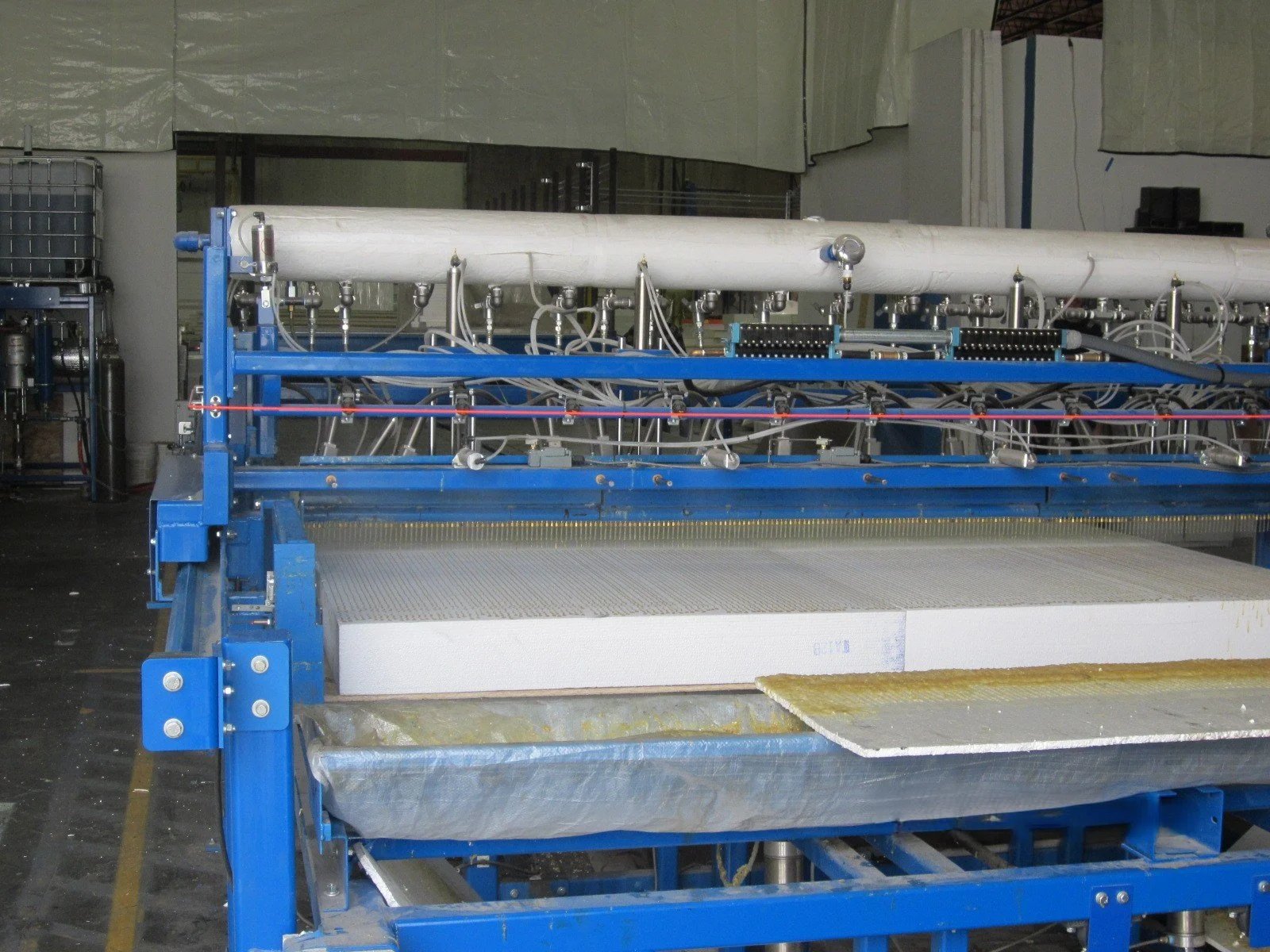
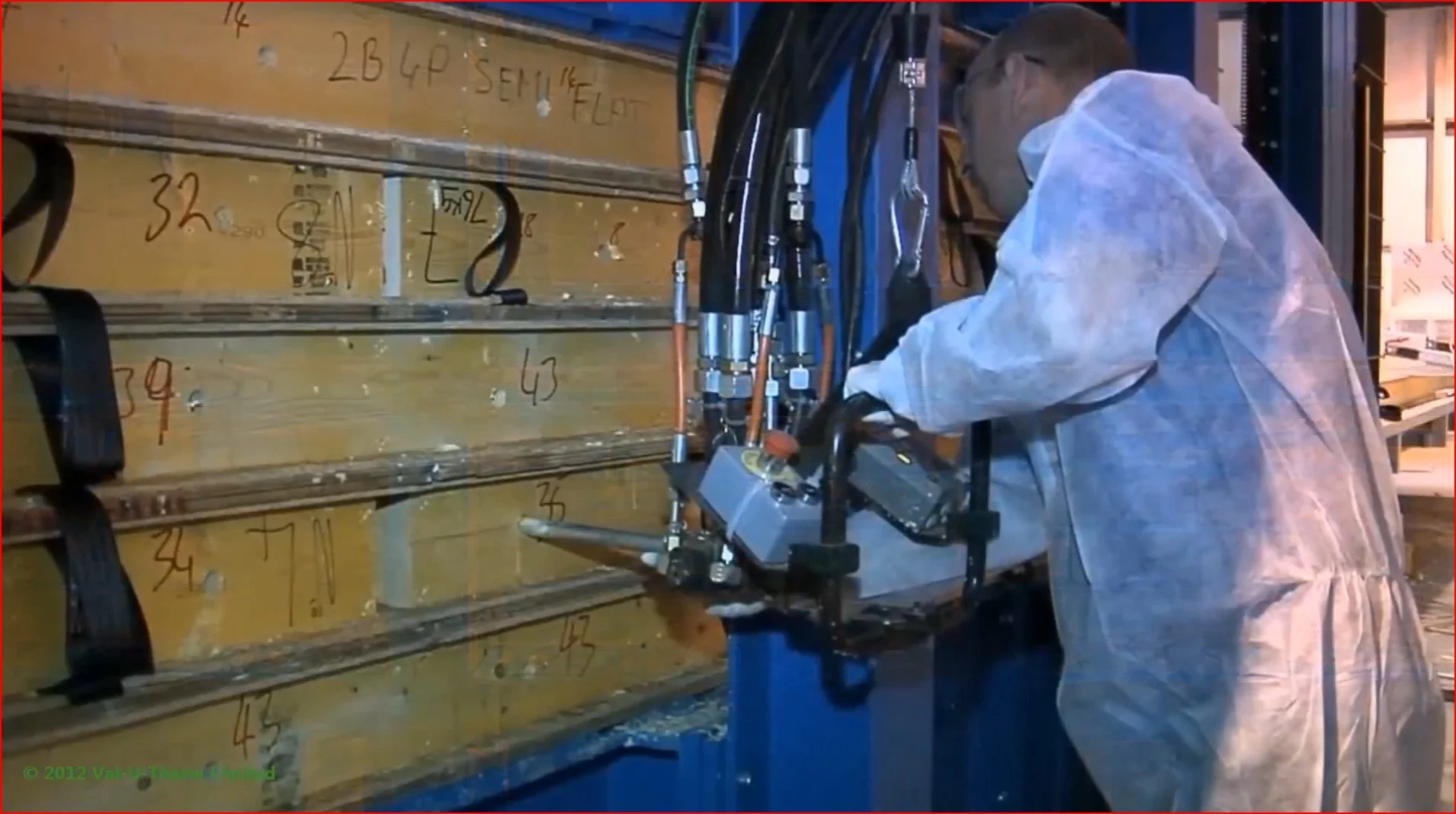
PU adhesives can be applied manually, by spray, or with automated bead or roller systems. In PUR-core SIPs, liquid foam is often injected and expands to adhere to both facers. With EPS and XPS cores, bead or roller applied adhesives with pressure lamination is standard.
Epoxy Adhesives
Epoxy resin adhesives, while less common than PU in mass SIP production due to cost and slower cure times, offer superior bond strength, chemical resistance, and thermal stability. They are prevalent in specialty, high-performance, or retrofit assemblies and for anchoring or reinforcement applications.
Polyvinyl Acetate (PVA) Adhesives
PVA adhesives persisted through the 1980s–1990s for foam-to-wood bonding in lower-performance or non-critical applications, especially in site-assembled panels. Modern iterations (Type II water-resistant PVA) offer improved environmental and handling characteristics, but are typically reserved for interior applications and non-structural SIPs .
PVA adhesives are not generally used as the primary adhesive for high-performance SIPs due to lower resistance to sustained moisture, cold, and heat cycles. However, certain manufacturers still specify PVA in interior and non-loadbearing applications, or for field joint sealing.
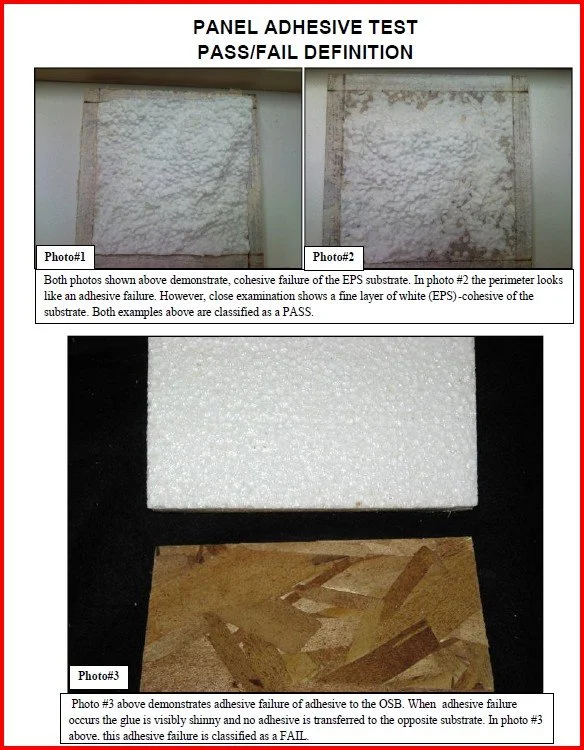
The Bond Line Is Structural
In SIP construction, the adhesive bond line is responsible for transferring shear forces between the facings and the core.
This is what allows the panel to behave as a composite structural element rather than separate materials.
If the bond line fails, the panel loses structural integrity.
What Can Go Wrong
Adhesive performance is highly dependent on manufacturing control.
Common issues include:
Inconsistent adhesive application
Poor surface preparation
Incorrect curing conditions (temperature, pressure, time)
Incompatible materials
These issues can lead to:
weak bond strength
localized failures
long-term delamination
Why Manufacturing Matters
Adhesives do not perform the same way in every environment. Performance depends on:
core material (EPS, GPS, PUR/PIR)
facing material (OSB, MgO, cementitious)
plant conditions and quality control
This is why SIP performance starts in the factory, not on the jobsite.
What Most People Overlook
Adhesives are often treated as a secondary component. In reality, they are one of the most critical parts of the system.
Most SIP manufacturers use moisture-cure polyurethane adhesives because they provide strong, durable bonds across a range of materials. But even the right adhesive will fail if the process is not controlled.
In many cases, bond line failures are not isolated issues, but indicators of deeper manufacturing or system-level problems.
The System Perspective
Adhesive performance cannot be evaluated in isolation. It must be considered as part of the full system:
core behavior
facing material
environmental exposure
manufacturing consistency
When these align, SIPs perform extremely well.
When they do not, problems are often traced back to the bond line.
In forensic investigations, bond line failures are one of the most common indicators of deeper system or manufacturing issues.
How Do You Choose the Right SIP System?
Choosing a SIP system is not just about materials. It is about system alignment.
Evaluate:
Core type
Facing material
Adhesive type
Code compliance
Climate and performance goals
Manufacturer capabilities
Installation requirements
The best SIP system is the one where all components work together for your specific project.
PGS Consulting works with SIP manufacturers, builders, and design teams to evaluate building system performance, manufacturing processes, and installation practices. Learn more about PGS Consulting →
What Is a SIP Code Pathway?
A SIP code pathway is the method used to demonstrate that a Structural Insulated Panel system complies with building codes such as the International Building Code (IBC) or International Residential Code (IRC).
Unlike traditional framing, SIPs often require additional documentation or engineering to show compliance.
Why Code Pathways Matter
Code approval is not just a formality. It directly impacts:
how quickly a project gets approved
how much engineering is required
who carries responsibility for performance
how risk is managed across the project team
Misunderstanding the code pathway is one of the most common sources of delays and confusion in SIP projects.
The Two Primary SIP Code Pathways
1. Prescriptive Code
Some SIP applications are addressed directly in building codes.
Limited to specific conditions
Typically applies to residential construction
Less flexibility in design
This is the simplest pathway, but also the most restrictive.
2. Engineered Design (Performance-Based)
SIPs can also be approved through engineering analysis.
Based on 2024 IBC Section 104.2.3 or similar provisions
Allows design flexibility
Requires a licensed engineer
This pathway is often used for:
commercial buildings
complex geometries
projects outside prescriptive limits
Evaluation Reports (ICC-ES, CCMC, Etc.) - Not a Pathway by themselves
Evaluation Reports by themselves are not a pathway to code compliance. An evaluation report demonstrates that the described material properties meet the building code requirements. However each project must demonstrate that it, itself, meets the requirements of the building code as a system. An evaluation report is used with the engineered design pathway.
Most SIP manufacturers rely on third-party evaluation reports.
Documents compliance with building codes
Includes structural, thermal, and material performance data
Widely accepted by building officials
These reports provide a standardized way to demonstrate compliance, but they are specific to each manufacturer’s system.
Where Projects Get Into Trouble
Problems typically occur when the code pathway is not clearly defined early in the project.
Common issues include:
assuming SIPs are fully prescriptive in all cases
mismatching manufacturer reports with project design
incomplete or incorrect submittals
lack of coordination between design, engineering, and installation
These issues can lead to:
delayed approvals
redesign work
increased project risk
The Role of Engineering and Documentation
SIP systems rely heavily on:
engineering assumptions
manufacturer data
installation details
project-specific conditions
Clear documentation is essential to align all of these pieces. This includes:
load paths and structural design
connection details
thermal and moisture considerations
compliance documentation
The System Perspective
Code compliance should not be treated as a standalone step. It is part of the overall system that includes:
design
manufacturing
installation
performance expectations
When the code pathway is clear, projects move more efficiently. When it is not, problems tend to surface later in the process.
Many SIP-related project issues are not caused by the panels themselves, but by gaps between design intent, code compliance, and system execution.
Talk to Joe About Your SIP Project
PGS Consulting works with manufacturers, builders, and design teams to evaluate SIP systems, manufacturing processes, and installation practices.
If you are planning a project, refining a process, or working through a performance issue, clear guidance early can prevent costly problems later.
Joe Pasma, PE brings more than 40 years of experience in SIP engineering, manufacturing, installation, and forensic analysis.
Frequently Asked Questions About SIP Panels
What is the most common SIP core?
EPS (expanded polystyrene) is the most common SIP core in North America. It is stable, cost-effective, and has the longest track record in SIP manufacturing, testing, and code evaluation. Most SIP manufacturers build their standard panel lines around EPS, which also makes it the easiest core to source and specify.
Can I switch from an EPS core to GPS or PUR/PIR?
Often yes, but the two switches are not the same. GPS (graphite polystyrene) generally improves thermal performance without changing how the panel is manufactured, detailed, or installed. PUR/PIR delivers the highest initial R-value, typically R-6.5 to R-7.2 per inch, but it is a different manufacturing process with its own tradeoffs. Confirm the change with your manufacturer and engineer before you commit.
Why does the adhesive matter in a SIP?
The adhesive is what makes a SIP structural. The bond between the core and the facings lets the panel act as one composite unit instead of three separate layers, which is where its strength and stiffness come from. Adhesive type, application method, and manufacturing quality control all affect how well that bond holds up over the life of the building.
Do SIPs require special approval?
SIPs are approved through one of two code pathways: prescriptive code or engineered design. The prescriptive pathway applies when a project falls within the limits the residential code sets for SIP construction. Projects outside those limits need an engineered design. Evaluation reports, such as ICC-ES, document how a specific panel performs and support approval, but they are not a pathway on their own.
Are SIPs better than traditional framing?
SIPs offer clear advantages over traditional framing: continuous insulation, lower air leakage, and faster installation with fewer job-site steps. Those benefits depend on the system being designed, detailed, and installed correctly, so the panels and the details around them need to be treated as one system from the start.
About the Author
Joe Pasma, PE is a licensed professional engineer with more than 40 years of experience in Structural Insulated Panels and advanced building systems. His background includes engineering, manufacturing systems, installation oversight, and forensic engineering.
Through PGS Consulting LLC, Joe helps manufacturers, builders, architects, building owners, and project teams improve system performance, reduce risk, and bring clarity to complex building challenges.
