
SIP RESOURCES
SIP FAQ: Common Questions About Structural Insulated Panels
Real answers from the field, written by Joe Pasma, PE, with more than 40 years of SIP engineering, manufacturing, and field experience. Updated May 2026
Definition
Structural Insulated Panels (SIPs) are prefabricated building components made of two structural facings — typically OSB — bonded to a rigid foam insulation core. They function as structure, insulation, and air barrier in one system, used for walls, roofs, and floors in residential and commercial construction.
SIPs show up in a lot of conversations about high-performance building. They also show up in a lot of misconceptions. This page answers the questions that builders, homeowners, designers, and code officials actually ask — without overselling the product or pretending the challenges do not exist.
Every answer on this page comes from field experience, not a marketing sheet.
Key Takeaways
SIPs cost more upfront than stick framing, but total project cost often narrows — and total cost of ownership over 30 years often favors SIPs
Moisture problems are preventable. The panel is not the weak point — joints, penetrations, and roof transitions are
SIPs are fully code-compliant under IRC Section R610 and IBC Alternative Materials, with manufacturer-specific evaluation reports to support permits
Installation is faster than stick framing — but only when the crew has reviewed shop drawings before arriving on site
Most field failures trace back to poor coordination, not poor panels
Jump to a section:
SIP Basics
What are SIPs?
Structural Insulated Panels are prefabricated building panels made of a rigid foam core bonded between two structural facings, almost always OSB. The three layers bond under pressure to form a single composite unit. That composite behavior is what makes SIPs perform — the facings carry loads, the core stabilizes the assembly, and the whole thing acts together as structure and insulation in one.
In conventional framing, studs carry load and insulation fills the gaps between them. In a SIP, those functions are combined, which is why SIP walls are stiffer, tighter, and more thermally continuous than their stick-framed counterparts.
Related: What Are SIPs? — A Complete Guide
How are SIPs made?
Most SIPs start as a foam billet cut to size. OSB facings are prepared, structural adhesive is applied, and the assembly is pressed under controlled pressure until the bond cures. CNC equipment then cuts openings, electrical chases, and panel profiles based on project-specific shop drawings.
What happens inside the plant matters. Bond quality, adhesive consistency, and cut accuracy all affect how panels perform on site and how long they last. Manufacturers differ in their press systems, quality control processes, and what they catch before panels ship.
Related: SIP Manufacturers in North America
What problems do SIPs solve?
SIPs address four persistent issues in conventional construction: thermal bridging, air leakage, inconsistent insulation, and slow assembly. By combining structure, insulation, and sheathing into one component, they reduce the number of steps required to close in a high-performance building. For teams trying to hit modern energy codes without layering on complex assemblies, SIPs offer a more direct path.
How long do SIPs last?
When properly detailed and protected from water intrusion, SIPs have service lives comparable to or longer than conventional framing. The foam cores do not degrade under normal conditions. The OSB facings are the same OSB used in roofs and walls everywhere. Where failures occur, they are almost always traced to moisture at joints, penetrations, or roof transitions — not the panels themselves.
Are SIPs code-approved?
Yes. SIPs are recognized in the International Residential Code (IRC Section R610) and the International Building Code as an alternative material. Most manufacturers carry ICC-ES evaluation reports or equivalent third-party documentation that outlines allowable spans, loads, and fastening requirements for their specific products.
Designers still need to address local amendments, snow loads, seismic conditions, and fire-resistance requirements. Within their listed parameters, SIPs are fully code-compliant structural components with an established permitting track record across North America.
Cost, Value, and Insurance
Are SIPs more expensive than stick framing?
The material cost is typically higher. The total project cost is a more complicated picture.
SIPs reduce framing time, cut air-sealing labor, and often allow HVAC systems to be down sized. Many builders find that those savings offset a significant portion of the panel premium. Over the life of a building — lower energy bills, fewer callback repairs, smaller mechanical systems — the cost equation shifts further.
The honest answer: first cost favors stick framing. Total cost of ownership over 30 years often favors SIPs. Whether that math works for your project depends on local labor rates, energy costs, and how the building is designed.
Related: SIP Cost Guide — 30-Year Comparison
What affects SIP pricing?
Panel thickness is the biggest driver — thicker panels cost more, and roof panels cost more than wall panels. Core type matters: polyurethane cores cost more per panel than EPS. Region and shipping add up quickly on large projects or remote sites.
Design decisions also drive cost. Complex rooflines, unusual window placements, and irregular panel layouts increase waste and labor. Whether panels arrive blank, pre-cut, or ready-to-assemble (RTA) also shifts the price. Coordinating with a manufacturer during design — not after drawings are complete — is the most reliable way to control the panel package cost.
Related: SIP Manufacturers in North America
Do SIPs reduce labor costs?
On experienced crews, yes — often significantly. SIPs combine framing, sheathing, insulating, and air-sealing into one installation step, which eliminates multiple trade visits and speeds up the schedule.
The caveat is real: first-time crews move slower. Panel handling, joint sequencing, and sealant application require a learning curve that eats into schedule savings on early jobs. Labor savings are most consistent on simple, well-designed projects where the crew has reviewed shop drawings before arriving on site.
Do SIPs qualify for insurance discounts?
Some insurers offer incentives for high-performance or resilient construction, particularly when SIPs contribute to airtightness, energy efficiency, or wind resistance. SIP roofs can perform well in uplift testing when properly engineered, which may support FORTIFIED-style designations.
Discounts vary by region and carrier. Documentation matters — insurers who offer performance-based incentives will ask for it. SIPs alone do not guarantee a lower premium, but they can support a broader resilience strategy that does.
Design and Engineering
How do you design a SIP structure?
SIP design is a systems exercise, not a substitution exercise. You cannot take a stick-frame set of drawings and swap in SIPs without rethinking the panel layout, load paths, electrical routing, and air-barrier strategy. The best SIP projects treat the enclosure as one coordinated system from the start.
Most manufacturers provide engineering support or require shop drawings to confirm the design aligns with their listings. The key inputs: simple geometry, continuous load paths, and clear transitions between SIP assemblies and conventional framing.
What are the main design limitations?
SIPs perform best when loads are predictable and geometry is straightforward. Complex rooflines, heavy point loads, and large openings can require supplemental structure or hybrid framing approaches. Mechanical chases, plumbing stacks, and ductwork need intentional routing — they cannot be added as an afterthought once panels are ordered.
Moisture management at roof transitions and penetrations is a design requirement, not a construction afterthought. None of these are deal-breakers. They are design-stage items that experienced teams handle before shop drawings go to the plant.
Can SIPs handle snow, wind, and seismic loads?
Yes — within engineered limits. SIPs have strong bending stiffness due to their composite action, making them well-suited to high-load environments. Roof panels carry significant snow loads on projects across cold-climate North America. Wall panels resist lateral loads in wind and seismic conditions when properly anchored and connected.
Non-prescriptive conditions require project-specific engineering. Connection detailing is usually where performance is won or lost — the panels themselves are rarely the weak point.
Related: SIP Building Codes and Compliance
How do you run wiring and plumbing in SIPs?
Most SIPs include pre-cut electrical chases that allow wiring to be pulled through the foam core. Electricians need to know where those chases are and what tools to use — standard spade bits through a SIP face are a quick way to damage a panel. Plumbing is generally kept out of exterior SIP walls for both thermal and access reasons.
When mechanical systems need to intersect SIP panels, routing has to be designed before shop drawings go to the plant. Field improvisation that involves cutting into panels compromises structure or air-sealing and is expensive to fix.
What is a project-specific system?
A project-specific system means the SIP enclosure is engineered and detailed for that exact building — not adapted from a generic layout. It includes panel placement, structural connections, joint details, placement sequencing, air-barrier continuity, and transitions to adjacent assemblies.
When every team member understands the building as a complete system, installation becomes predictable and failures become rare. When they do not, field improvisation fills the gap — and that is where most SIP problems start.
PGS Consulting LLC Field Note
In every SIP failure investigation we have conducted, the panel was not the source of the problem. The source was a breakdown in the system around it — missing adhesive at a joint, a roof transition left unsealed, a panel edge exposed to weather during construction, the use of low perm WRBs and roofing underlayments. The panel holds up when the installation supports it.
Installation and Jobsite Workflow
How long does SIP installation take?
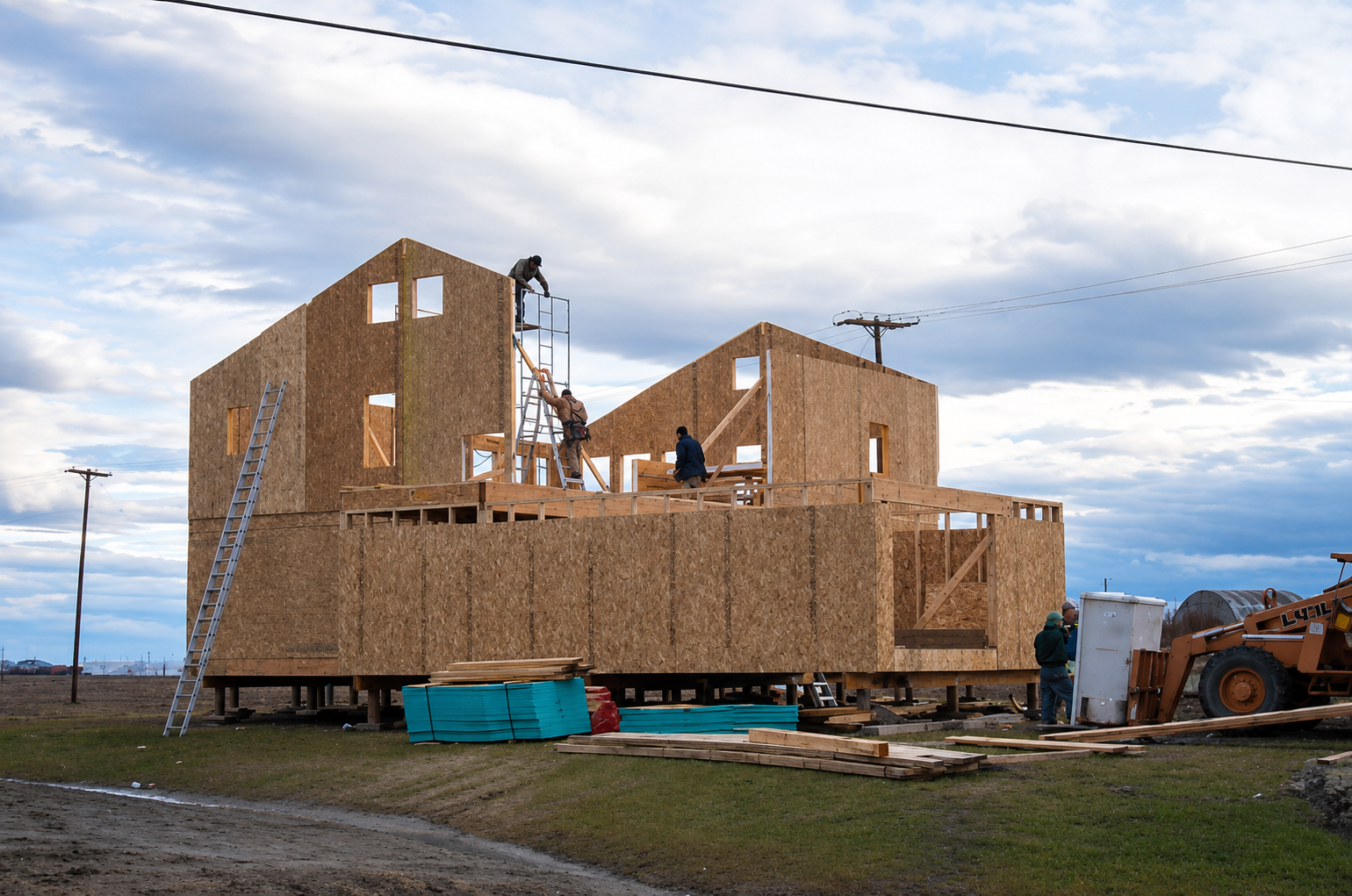
Faster than stick framing — often significantly — once the crew understands the workflow. Walls can be erected in hours. Simple roofs can go up in a day or two. The time savings come from eliminating separate steps for sheathing, insulating, and air-sealing.
Schedule depends on lifting equipment access, panel size, crew experience, and weather. A crew walking onto their first SIP project without having reviewed shop drawings will take much longer than the numbers suggest. Preparation determines pace.
What does a GC need to know before their first SIP project?
Panel handling, lifting points, joint sealing, and sequencing — and all of it before breaking ground, not on the first morning of panel installation. SIPs reward planning and punish improvisation.
The GC should review shop drawings with each trade, confirm equipment logistics and panel staging, and establish weather protection protocols for exposed panels and splines. When the GC sets expectations and manages sequence, SIP projects run smoothly even for first-time crews.
What equipment is needed to lift and place panels?
Most SIP projects use a telehandler, skid-steer or small boom truck, particularly for roof panels. Manufacturers provide lifting details — straps, plates, or integrated lifting points. Proper rigging protects the OSB skins and panel joints from damage during placement. Smaller wall panels can be set manually, but mechanical assistance improves both safety and speed.
How do you coordinate trades on a SIP job?
A short pre-construction meeting with all trades prevents most coordination problems. Electricians need chase diagrams. HVAC contractors need routing plans. Framers need panel layout drawings. Because SIPs arrive pre-cut to the project's shop drawings, field modifications should be the exception, not the solution to a planning gap.
When every trade understands the system before they show up, unplanned cuts and improvised penetrations stay off the site.
What causes SIP installation failures?
Most failures trace back to three things: missing sealant and SIP tape, moisture intrusion, and unplanned field cuts. Rushed installation and poorly detailed roof transitions are the most common contributors.
The panels themselves are rarely the problem. Failures are almost always the result of workflow breakdowns — skipped sealant, unsealed penetrations, panel edges left exposed to weather. When crews follow the manufacturer's details and maintain continuity of air and water control layers, failures are rare.
PGS Consulting LLC Field Note
In every SIP failure investigation we have conducted, the panel was not the source of the problem. The source was a breakdown in the system around it — missing adhesive at a joint, a roof transition left unsealed, a panel edge exposed to weather during construction, the use of low perm WRBs and roofing underlayments. The panel holds up when the installation supports it.
Moisture, Durability, and Maintenance
Do SIPs rot?
SIPs do not rot on their own. The foam core does not rot at all. The OSB facings can deteriorate if exposed to prolonged moisture — the same way any wood-based product can deteriorate.
Most moisture-related failures occur at joints, penetrations, or roof transitions where water bypasses the control layers, not at mid-panel. Proper flashing, air-sealing, and detailing prevent these failures. A SIP building that stays dry stays stable for decades.
How do you prevent moisture problems in SIP buildings?
Moisture control starts in design. Continuous air-sealing strategy, proper roof-to-wall transitions, and reliable flashing at every penetration have to be part of the plan before panels are ordered.
During installation, crews must follow manufacturer sealant requirements at every joint and protect exposed panel edges from weather. Ventilated roof assemblies, high perm WRBs and roofing underlayments, adequate overhangs, and drainage planes reduce risk further. When the enclosure is detailed as a system — not patched in the field — moisture problems are highly preventable.
What maintenance does a SIP building require?
SIP buildings require the same maintenance as any conventionally framed building: keep water away from the enclosure, maintain roof coverings, and ensure flashing stays intact. SIPs do not require special treatments or coatings under normal conditions.
The most important maintenance task is the same as in any wood-framed building — monitoring areas where water could enter. Gutters, roof penetrations, window flashing, and foundation transitions are where attention pays off.
Fire Performance
Are SIPs combustible?
Yes. SIPs contain wood facings and foam core, both of which are combustible materials. This is not unique to SIPs — most wood-frame building materials are combustible.
Fire performance of an assembly depends on how the system is detailed, not on the raw combustibility of its components. SIP assemblies meet fire-resistance requirements through gypsum board thermal barriers, tested assembly configurations, and manufacturer-specific details. Combustibility of materials and fire rating of assemblies are different things.
How do SIPs perform in fire tests?
SIP assemblies can achieve one-hour or greater fire ratings when tested with appropriate coverings and configurations. The gypsum layer protects the foam core and delays heat transfer. Performance varies by manufacturer and assembly, so the specific evaluation report and tested configuration govern compliance. Field modifications must not compromise a tested assembly.
Manufacturers and Supply Chain
Who makes SIPs in North America?
More than 40 established manufacturers operate across the U.S. and Canada. They vary in core material, panel size, production capacity, regional availability, and the types of projects they serve. Some focus on residential work; others specialize in commercial, institutional, or cold storage applications.
Availability, lead times, and pricing all shift by region. Engaging a manufacturer during design — not after drawings are complete — is the most reliable way to align panel capabilities with project requirements.
Related: SIP Manufacturers in North America
What is the difference between EPS, GPS, and polyurethane cores?
EPS (expanded polystyrene) is the most common core type. It is cost-effective, dimensionally stable, and its R-value holds steady over time without degradation. Most residential SIP projects use EPS, with R-values of R-3.6 to R-4.5 per inch.
GPS (graphite polystyrene) is EPS with graphite particles added. It delivers R-4.7 to R-5.1 per inch with the same handling characteristics and no R-value drift. It is a straightforward performance upgrade for high-performance or net-zero projects.
Polyurethane and polyisocyanurate (PUR/PIR) cores start at the highest R-value per inch — R-6.0 to R-7.2 — but experience thermal drift over time. Long-term performance settles closer to R-5.0 to R-6.5 per inch. For most residential projects, EPS or GPS is the better long-term choice.
Core Type Comparison
| Core Type | R-Value per Inch | R-Value Drift? | Best For |
|---|---|---|---|
| EPS | R-3.6 to R-4.5 | No | Residential, light commercial, best cost-to-value |
| GPS | R-4.7 to R-5.1 | No | High-performance and net-zero projects |
| PUR/PIR | R-6.0 to R-7.2 initial R-5.0 to R-6.5 aged |
Yes | Commercial, cold storage, thin panel applications including residential |
EPS
GPS
PUR/PIR
How long are SIP lead times?
Typically 3 to 8 weeks, depending on season, region, manufacturer capacity, and project complexity. Large or heavily customized projects may require additional engineering time before production begins.
Early engagement with the manufacturer helps avoid delays. Panel layout decisions made late in design can push a project to the back of the production queue or require design revisions that add weeks.
Myths and Misconceptions
Some of the most common concerns about SIPs are not wrong — they are aimed at the wrong part of the system. Here is what the field actually shows.
"SIPs mold."
Mold requires two things: moisture and organic material. When SIPs are kept dry and properly sealed, mold is no more likely than in any other wood-based assembly. Most mold problems in SIP buildings trace back to air leaks at joints, poorly detailed roof transitions, or bulk water intrusion — not the panels. Good detailing and providing the opportunity to dry prevents those conditions.
"SIPs cannot be remodeled."
SIPs can be remodeled, but the process requires planning because the panels are structural. Openings, additions, and modifications need to be engineered to maintain load paths. Many remodels involve hybrid framing or supplemental structural elements. With proper design, SIP buildings can be adapted as thoroughly as conventionally framed structures. The constraint is engineering, not the panel.
"SIPs are only for custom homes."
SIPs are used in single-family homes, commercial buildings, schools, apartments, cold storage facilities, and multifamily projects. The perception that they are a niche product comes from limited regional adoption in some markets, not from any technical restriction on where they can be applied.
"SIPs are too complicated for trades."
Trades unfamiliar with SIPs assume complexity that is not there once they understand the system. Most challenges on first SIP projects stem from lack of early coordination — not from the panels being genuinely difficult. Once all trades understand what to expect, the work becomes predictable. SIPs often simplify tasks by eliminating separate air-sealing and insulation steps entirely.
"SIPs are not allowed by code."
SIPs are recognized in the IRC and IBC and are used in permitted projects across North America every day. Code concerns almost always arise from a plan checker or inspector who has not reviewed a SIP project before — not from actual code restrictions. Manufacturer evaluation reports and third-party compliance documentation provide clear pathways to permit approval.
Go Deeper: From the SIP Blog
Engineer-authored articles by Joe Pasma, PE, organized by what you're trying to figure out.
SIP Fundamentals and Building Science
How SIPs work, how they perform, and how they compare to stick framing.
Read More →SIP Cost and Budgeting
What SIPs actually cost and how to evaluate a quote.
Read More →SIP Design and Code Compliance
Code requirements and design decisions for architects and engineers.
Read More →SIP Manufacturing and Manufacturer Selection
How SIPs are made and how to evaluate a manufacturer.
Read More →SIP Installation and Construction
Field guidance for GCs, framers, and subcontractors.
Read More →SIP Failures and Forensic Analysis
Independent analysis of SIP failures, moisture, fire performance, and forensic case work.
Read More →Consulting Insights
How PGS Consulting works and how independent SIP consulting engagements run.
Read More →About the Author
Joe Pasma, PE is a licensed professional engineer with more than 40 years of experience in SIP structural engineering, manufacturing operations, installation oversight, and forensic analysis. He has worked inside SIP plants across North America, reviewed hundreds of SIP projects from design through construction, and provided expert witness analysis in SIP-related litigation. PGS Consulting LLC provides independent SIP consulting, not tied to any manufacturer.
Learn About Our Consulting Services →Explore the SIP Resources Library
This page is part of the PGS Consulting LLC SIP Resources hub -- an independent, engineer-authored library covering major aspects of SIP construction.
What Are SIPs?
A complete guide to how SIPs work, what they are made of, and what builders and designers need to know before using them.
Read More →SIPs vs. Stick Framing
A detailed comparison of SIP and stick framing across cost, performance, speed, and long-term value.
Read More →SIP Cost Guide
What SIPs actually cost, how to compare them to alternatives, and what the 30-year ownership picture looks like.
Read More →SIP R-Value and Energy Performance
How SIP insulation values are measured, what real-world thermal performance looks like, and how SIPs compare to code minimums.
Read More →SIP Building Codes and Compliance
Code pathways, IRC and IBC provisions, evaluation reports, and what engineers and AHJs need to know.
Read More →SIP Installation Guide
Installation sequencing, connection details, common errors, and what proper field execution requires.
Read More →SIP Problems and Failures
The most common SIP failures, why they happen, and what forensic analysis reveals about root cause.
Read More →SIP Manufacturers
An independent review of the SIP manufacturing landscape: who makes them and what to evaluate before buying.
Read More →Have a Question?
Have a SIP Question That Is Not Answered Here?
PGS Consulting LLC provides independent, advisory-only support for builders, designers, engineers, and project teams. We do not sell panels, install panels, or act as a general contractor. Our job is to help you understand what you are working with — and avoid preventable mistakes.
Ask Joe a Question →