
Are SIPs Combustible? Fire Performance, Codes, and What Actually Keeps You Safe
Are SIPs combustible? Yes -- but that doesn't mean unsafe. Learn how OSB and EPS behave in fire, what the building code requires, and why properly installed SIP assemblies perform predictably and safely.
By Joe Pasma, PE | PGS Consulting LLC, Licensed Professional Engineer | 40+ Years in SIP Engineering, Manufacturing, and Forensic Analysis
It's one of the first questions I hear from people seriously considering SIP construction: "Wait -- isn't that foam? Doesn’t it burn?"
Yes. SIPs contain combustible materials. Both the OSB skins and the foam core will burn. I'm not going to sugarcoat that.
But here's the part that most articles skip over: combustible does not mean unpredictable. It does not mean unsafe. And it does not mean SIPs perform worse in a fire than traditional stick framing.
Fire safety in construction is never about a single material. It's about the whole assembly -- how the pieces work together, what barriers are in place, and whether everything was installed correctly. SIP assemblies are among the most thoroughly tested, tightly regulated, and predictable systems in residential construction today.
This article walks through what "combustible" actually means, how the materials in SIPs behave when exposed to fire, what the building code requires, and what real-world fire performance looks like.
KEY TAKEAWAYS
SIPs are combustible -- both the OSB skins and the foam core will burn when exposed to sufficient heat.
Combustible does not mean unsafe. Fire safety is determined at the assembly level, not the material level.
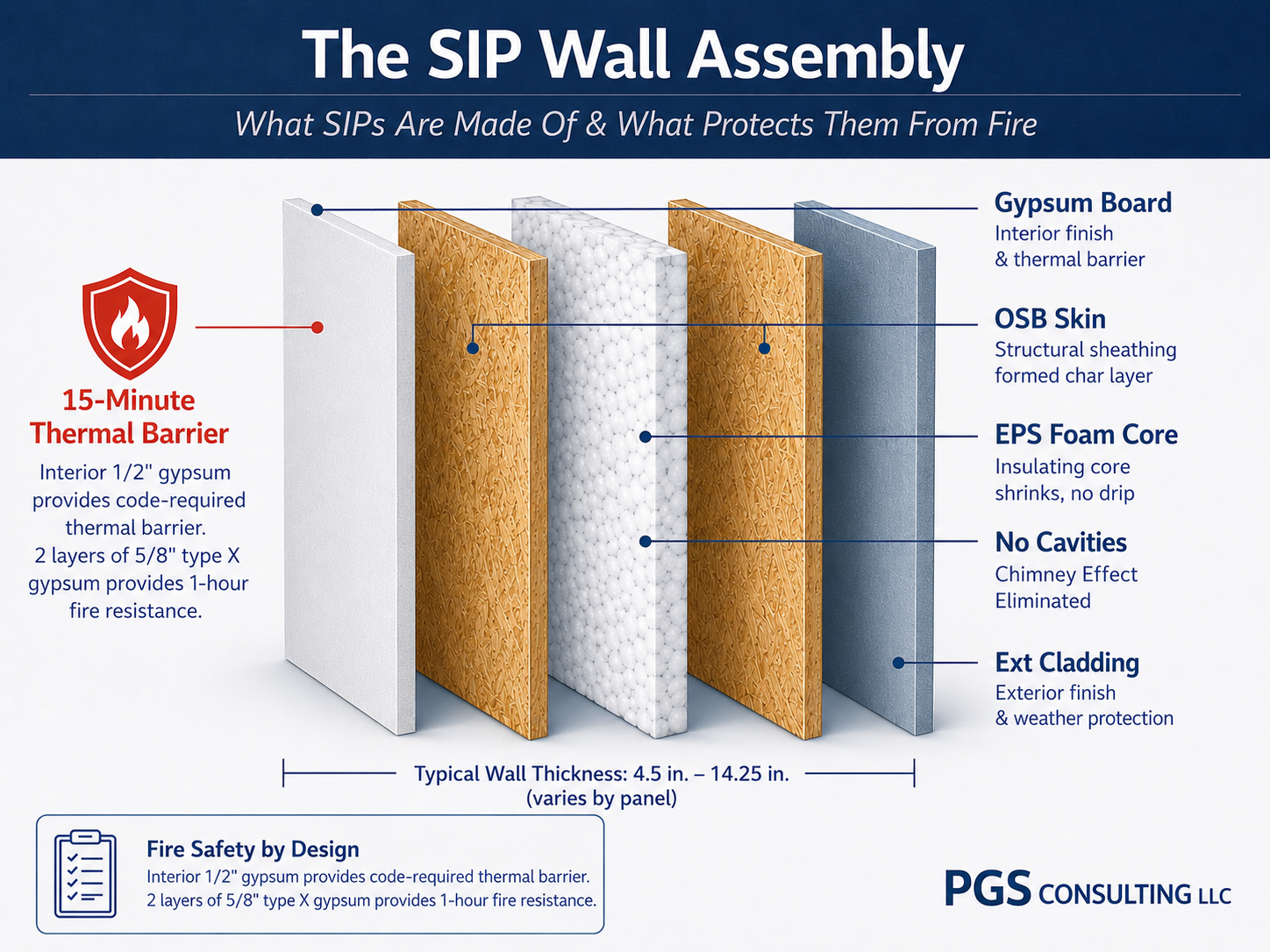
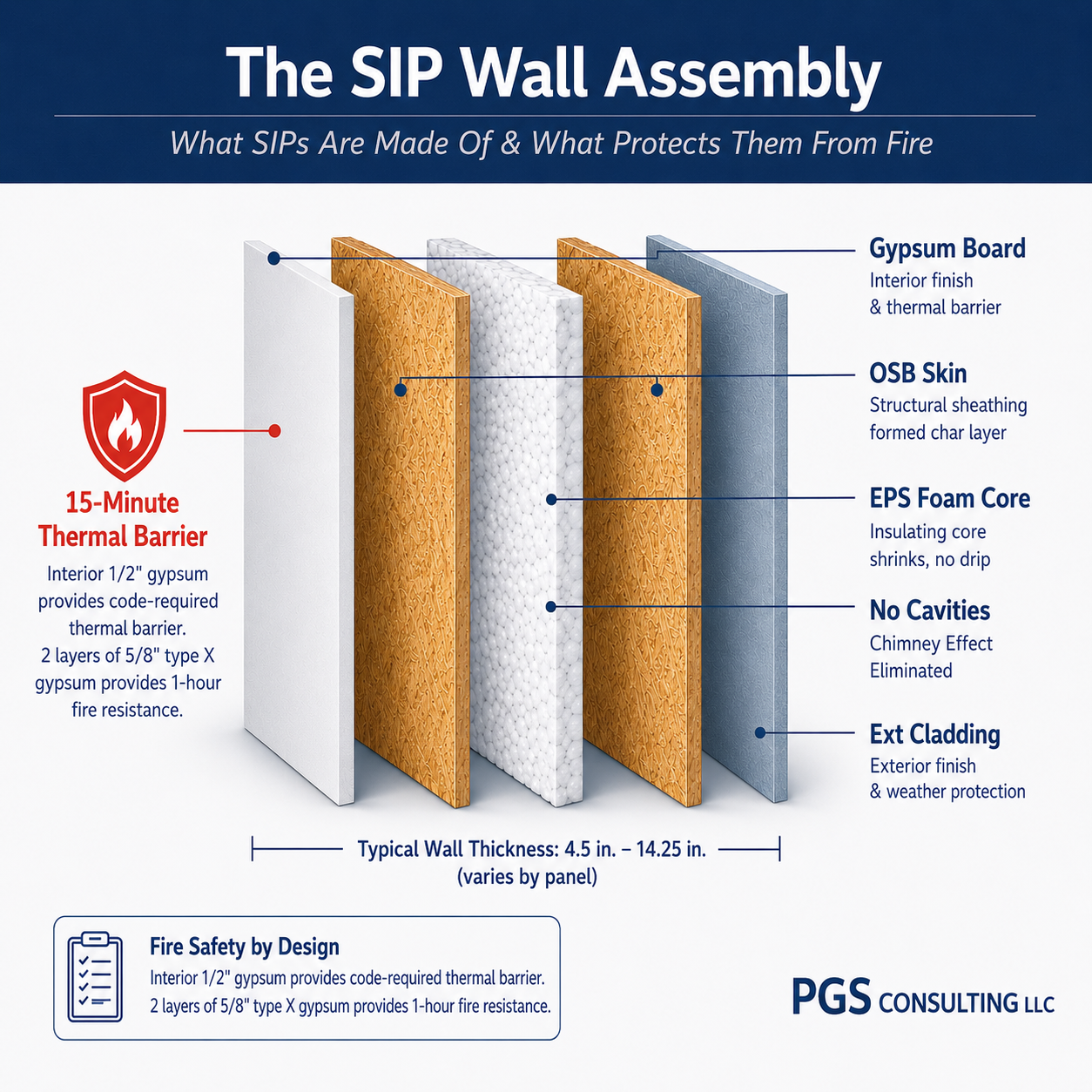
Building codes require a thermal barrier -- typically 1/2-inch gypsum board -- to protect the foam core and delay heat transfer for a minimum of 15 minutes.
SIPs eliminate the stud-cavity chimney effect found in stick framing, which is a meaningful advantage in a fire.
SIP assemblies are tested to ASTM standards and manufacturers must provide third-party compliance reports like an ICC-ES evaluation report documenting code compliance.
Proper installation is non-negotiable. A correctly installed SIP system with continuous gypsum performs predictably. Shortcuts during installation eliminate that protection.
What "Combustible" Actually Means -- and What It Doesn't
The building code sorts materials into two buckets: combustible and non-combustible.
Foam plastics -- like EPS, GPS, and polyurethane (PUR/PIR) -- are considered combustible. OSB is combustible. So is dimensional lumber. So is virtually every structural material used in standard residential construction.
Here's the thing most people don't realize: the code allows combustible materials in residential buildings all the time. What the code cares about is whether the assembly -- the combination of materials, barriers, and installation details -- meets fire performance requirements.
A combustible material inside a properly protected assembly is not a fire hazard. It's just construction.
How the OSB Skins Behave in Fire
OSB is a wood-based panel, and like all wood, it will ignite and burn. But it doesn't just disappear.
When OSB is exposed to fire, it forms a protective char layer on the surface. That char slows heat transfer into the material behind it. This is the same behavior that makes mass timber construction code-approved, and it's the same reason wood-framed homes have been built safely for over a century.
What OSB does not do:
It does not melt
It does not drip burning material
It does not collapse instantly
OSB's fire behavior is well understood by fire engineers. It's a known, modeled, engineered-for property -- not a wild card.
The takeaway: OSB is combustible, but it burns in a predictable, controlled way that engineers account for in assembly design.
How the Foam Core Behaves in Fire
EPS foam behaves differently than OSB, and it's worth being precise about this.
EPS will ignite when exposed to sufficient heat. Unlike OSB, it does not form a char layer -- it shrinks away from the heat source instead. Construction-grade EPS is also treated with a flame retardant, which means it will not sustain an open flame without a continuous external ignition source.
What this means practically: if the gypsum thermal barrier on the interior of a SIP wall is intact and properly installed, the foam core is effectively shielded from heat long enough for occupants to exit and for fire suppression to respond. The foam never has a chance to become the problem.
This is exactly why the building code requires a thermal barrier. It's not a workaround or a patch -- it's the engineered solution.
The takeaway: EPS combustibility is managed through assembly design. The gypsum or an approved thermal barrier is not optional.
What the Building Code Actually Requires
Foam plastics are only permitted in residential construction when protected by a thermal barrier. For SIP walls, that almost always means:
1/2-inch gypsum board on the interior face
Installed continuously, with no gaps
Providing a minimum 15-minute fire-resistance rating
SIP manufacturers test their assemblies to two primary ASTM standards:
ASTM E119 -- tests the fire resistance of building assemblies as a whole
ASTM E84 -- tests surface burning characteristics of individual materials
Both tests produce the data that goes into a third-party authored compliance report like an ICC-ES evaluation report. Those reports are publicly available and document exactly what a manufacturer's panels are approved for, under what conditions, and with what installation requirements.
Enercept, for example, publishes their ICC-ES evaluation report (ESR-4693) on their website. Any SIP manufacturer worth working with has an equivalent document. The SIPA SIP Manufacturing members all have a third-party listing report.
The takeaway: Code compliance for SIPs is not a gray area. The requirements are specific, the testing is standardized, and the documentation is publicly accessible.
Why Gypsum? The Science Behind the Thermal Barrier
Most people know the rule -- SIP walls require gypsum on the interior face. Fewer people know why gypsum specifically, and why that matters.
It's not just about thickness. Gypsum does something most building materials can't: it fights fire with chemistry.
Gypsum board contains water that is chemically bound inside its molecular structure -- not liquid water you can see or feel, but water locked into the material itself at a molecular level. When gypsum is exposed to heat, it releases that bound water as steam. That process absorbs an enormous amount of heat energy acting like a built-in air conditioner that delays heat transfer and keeps the surface behind the gypsum significantly cooler for an extended period of time.
That's what creates the 15-minute thermal barrier rating. It's not just a physical shield sitting between the fire and the foam. It's an active chemical process that consumes heat before that heat can reach the EPS core.
Even after complete calcination, when all the water has been released, the gypsum board continues to act as a heat-insulating barrier. Essentially, the board sacrifices itself to prevent the passage of heat and flame and does so in a sequential manner working back from the heat source. At that point, the material has done its job -- it has bought time. This is exactly why installation quality is non-negotiable. Gaps in the gypsum, missing sections at corners, or improperly taped joints all reduce the total water available to absorb heat. A compromised gypsum installation doesn't just look wrong -- it physically shortens the time the assembly can hold.
This is also why the code specifies continuous installation. Every inch of gypsum on that wall is contributing to the thermal delay. Treat it like the structural component it is.
Why SIPs Don't Have the "Chimney Effect" Problem
This is one of the most important fire performance differences between SIPs and stick framing, and it's often overlooked.
In conventional wood-frame construction, walls and floor assemblies contain open cavities between studs and joists. When a fire starts, those cavities act like chimneys -- they channel air and allow flames to travel vertically through a wall much faster than the surface materials alone would burn.
SIPs eliminate this pathway entirely.
There are no open cavities. The foam core is continuous from one face to the other. The assembly is airtight. There is nowhere for fire to race through.
Real-world evidence backs this up. Enercept documented a residential fire in which the stick-framed roof section collapsed while the SIP walls remained standing. Their explanation aligns with the physics: without stud-bay air channels, vertical fire spread slows dramatically.
The takeaway: The same feature that makes SIPs energy-efficient -- the continuous, airtight core -- also reduces one of the most dangerous fire behaviors in traditional framing.
Fire performance: SIPs vs. stick framing
← Swipe to view full table
| Fire performance factor | SIPs | Stick framing |
|---|---|---|
| Open stud cavities | None Continuous foam core, no air channels |
Present Cavities between every stud bay |
| Chimney effect risk | Eliminated No pathway for vertical fire spread |
Present Stud bays channel heat and flame upward |
| Thermal barrier required | Yes -- gypsum ½ in. gypsum board, interior face |
Yes -- gypsum Same requirement, same material |
| Structural facing behavior | OSB forms a protective char layer; slows heat transfer | Dimensional lumber also chars; similar behavior |
| Core / insulation behavior | EPS shrinks from heat; treated with flame retardant; does not drip | Batt insulation (fiberglass or mineral wool) is typically non-combustible |
| Airtightness advantage | Yes Continuous assembly limits oxygen supply to fire |
No Drafty framing cavities feed combustion |
| Assembly fire-resistance testing | ASTM E119 and ASTM E84; ICC-ES evaluation report required | ASTM E119; code prescriptive compliance path |
| Real-world documented performance | SIP walls have remained standing after adjacent stick-framed sections collapsed (Enercept case study) | Standard residential fire performance; well-documented over decades |
What This Looks Like in a Real Fire
Let's put it together in plain terms.
In a fire scenario where a properly installed SIP home is involved:
The fire encounters the interior gypsum surface first
The gypsum delays heat transfer for at least 15 minutes -- enough time for evacuation
The foam core, protected by the gypsum, does not ignite immediately
Even as heat increases, the EPS shrinks rather than spreading flame
The continuous, airtight wall assembly slows vertical fire spread
The OSB skins eventually char, but that char layer slows further heat penetration
This is predictable, engineered behavior. It's not luck. It's the result of code-tested, ASTM-verified assembly design.
Where things go wrong is when installation is cut short. Gypsum that isn't continuous, panels that aren't properly sealed, or electrical penetrations that aren't correctly detailed can compromise the entire thermal barrier. That's why correct installation isn't just about structural performance -- it directly affects fire safety.
The Bottom Line
SIPs are combustible. So is almost every other material in a wood-framed home.
What makes a building safe in a fire is not whether its materials are combustible -- it's whether the assembly is properly designed, properly tested, and properly installed. On all three of those measures, SIPs hold up well.
The code requirements are clear. The testing standards are established. The performance data exists. When a SIP system is installed correctly, with the required thermal barriers and proper detailing, it behaves predictably in fire -- and in some important ways, better than stick framing.
Have a SIP Project That Needs an Independent Review?
Fire performance questions, code compliance concerns, or structural details that don't quite add up -- these are exactly the situations where an independent engineering review pays for itself. Joe Pasma, PE has 40+ years working directly in SIP engineering, manufacturing, and forensic analysis, including cases where fire performance was the central issue.
Contact Joe Pasma, PE to talk through what your project needs →
Frequently Asked Questions
Are SIPs combustible?
Yes. Both the OSB skins and the foam core are combustible materials. Fire safety is achieved at the assembly level, primarily through continuous gypsum thermal barriers and airtight construction.
Are SIPs safe in a fire?
Yes -- when installed correctly. SIP assemblies are tested to ASTM standards and must meet specific building code requirements for fire resistance. Proper installation of the required thermal barrier is essential.
Does OSB burn?
Yes, OSB is a wood product and will burn. But it forms a protective char layer when exposed to fire, which slows heat transfer and contributes to predictable, engineered fire performance.
Does EPS foam in SIPs burn?
EPS is combustible, but construction-grade EPS is treated with a flame retardant and will not sustain an open flame without a continuous external ignition source. A continuous gypsum thermal barrier is required to protect the foam core in any SIP assembly.
What keeps the foam from igniting in a SIP wall?
A continuously installed 1/2-inch gypsum board on the interior face of the wall. This thermal barrier delays heat transfer for at least 15 minutes, which meets the code-required standard. The foam behind it is also treated with a flame retardant.
Do SIPs burn faster than stick framing?
No -- and in some ways they burn more slowly. SIPs eliminate the open stud cavities found in stick framing, which removes the chimney effect that allows fire to spread rapidly through a conventional wall. Documented fire incidents show SIP walls remaining intact after adjacent stick-framed sections have failed.
Do SIPs meet building code fire requirements?
Yes. SIP manufacturers are required to have their assemblies tested to ASTM standards and must publish third-party compliance reports like an ICC-ES evaluation report documenting compliance with thermal barrier, ignition barrier, and fire-resistance requirements. These reports are publicly available. The SIPA SIP Manufacturing members all have a third-party listing report.
What happens if the gypsum is not installed correctly?
The thermal barrier is the primary fire safety mechanism for foam-core SIP panels. Gaps, missing sections, or improper installation of the gypsum can compromise the entire fire-resistance rating of the wall assembly. Correct installation is not optional -- it is a code requirement.
About the Author
Joe Pasma, PE is a licensed professional engineer and the founder of PGS Consulting LLC in White Bear Lake, Minnesota. He has spent more than 40 years working directly in SIP engineering, manufacturing operations, installation oversight, and forensic analysis. Joe has worked with SIP manufacturers, builders, designers, and legal teams across the country -- including cases involving fire performance, building failures, and code compliance disputes.
He is one of a small number of engineers in the United States with deep, hands-on experience across the full SIP lifecycle. Learn more about Joe Pasma, PE.
Understanding Structural Insulated Panels (SIPs): Core Types, Skins, and System Performance
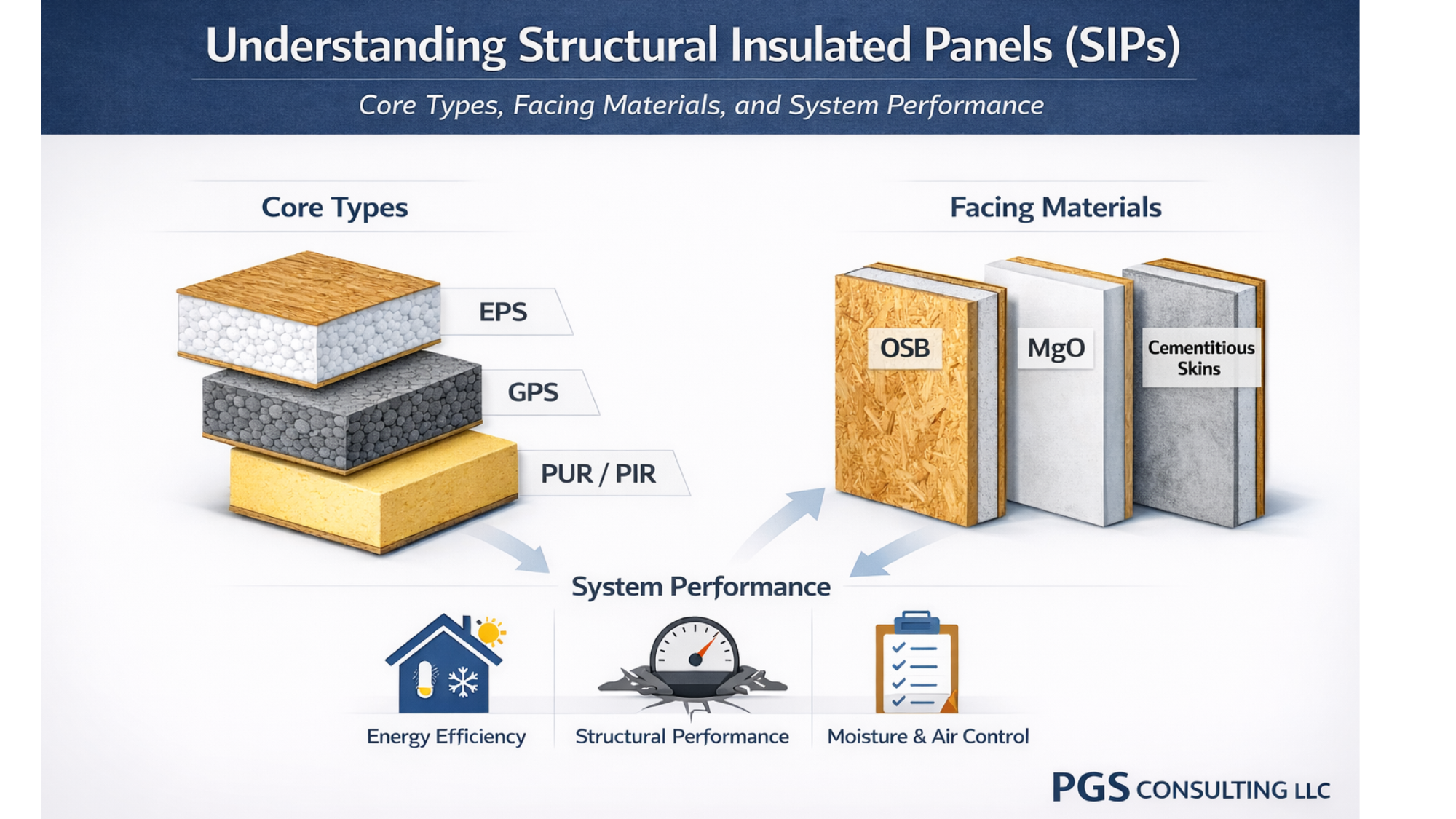
Understanding Structural Insulated Panels (SIPs) requires more than just knowing the materials. SIP performance depends on how core types, facing materials, adhesives, and system design work together. This guide breaks down EPS, GPS, and PUR/PIR cores alongside OSB, MgO, and cementitious facings to help builders, architects, and manufacturers make informed, system-based decisions.
By Joe Pasma, PE | PGS Consulting LLC, Licensed Professional Engineer | 40+ Years in SIP Engineering, Manufacturing, and Forensic Analysis
LAST UPDATED: APRIL, 2026
Structural Insulated Panels (SIPs) are often described as simple. Foam and skins.
But in real projects, they are anything but simple.
Performance depends on how the core, facings, adhesive, and code pathway work together. When those pieces align, SIPs deliver strong structural performance and energy efficiency. When they don’t, problems tend to show up quickly.
This guide breaks down SIP core types, SIP panel materials, and system considerations so builders, architects, and manufacturers can make informed decisions.
Who This Guide Is For
Builders evaluating SIP systems
Architects and designers designing high-performance envelopes
Manufacturers refining production and QA
Owners comparing building systems
Key Takeaways
SIPs are a composite building material, not just foam and skins
EPS is the most common and stable SIP core
GPS improves thermal performance by reducing radiant heat transfer
PUR/PIR offer higher R-values but include thermal drift and higher cost
OSB is the most widely used structural facing
Facing materials impact structure, fire resistance, and durability
SIP performance depends on system alignment, not individual materials
In simple terms:
SIP performance is not about one material. It is about how the core, facings, adhesive, and code pathway work together as a composite.
What Are Structural Insulated Panels (SIPs)?
Structural Insulated Panels (SIPs) are high-performance building panels made of an insulation core bonded between two structural facings, typically OSB. SIPs function as both structure and insulation, creating a strong, energy-efficient building envelope.
What Are the Main Types of SIP Core Materials?
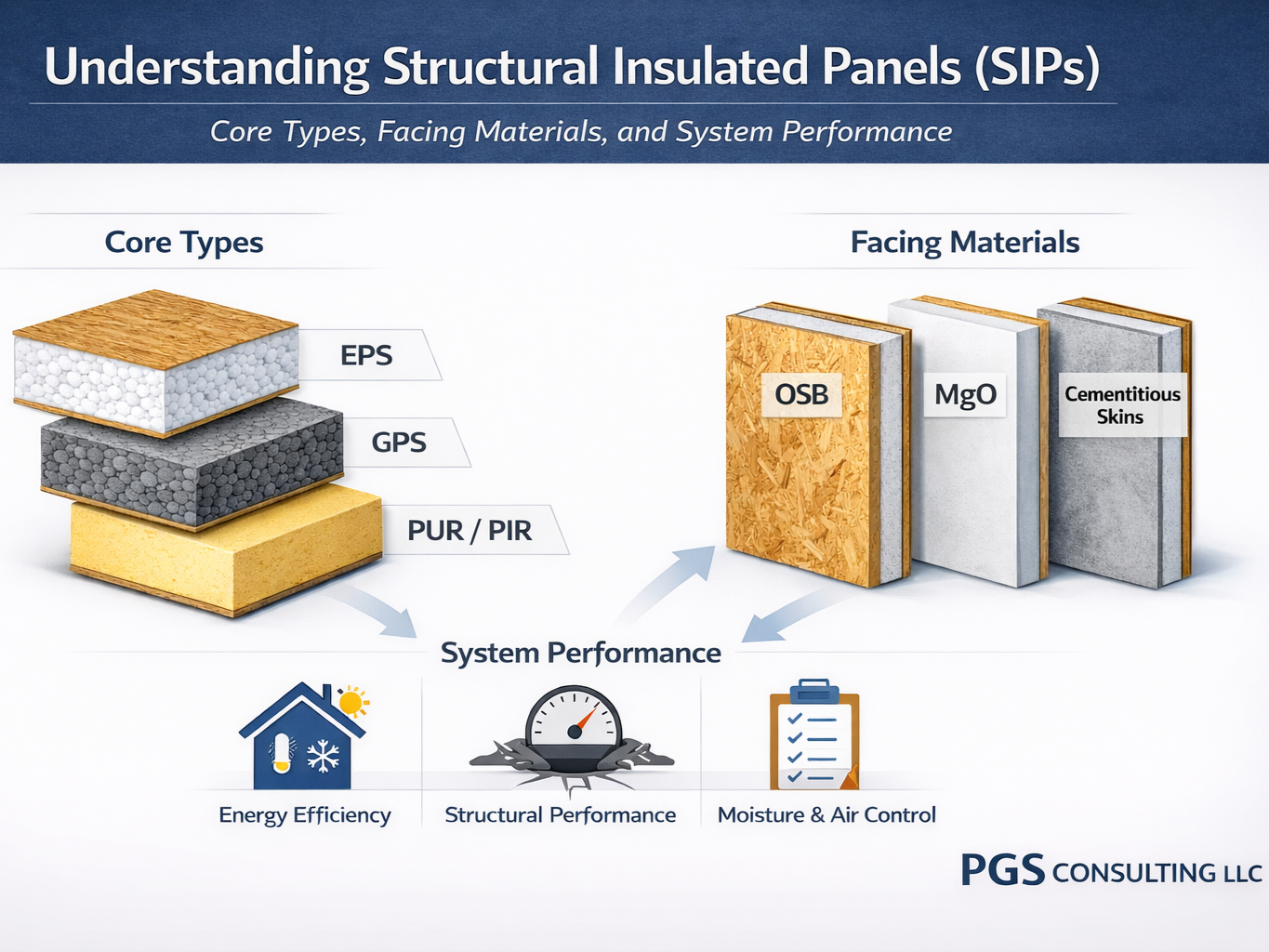
The three primary SIP core materials are EPS (expanded polystyrene), GPS (graphite polystyrene), and PUR/PIR (polyurethane-based foam). Each core type differs in thermal performance, cost, long-term stability, and manufacturing complexity.
EPS (Expanded Polystyrene): The most widely used SIP core, known for stability, predictability, and cost efficiency
GPS (Graphite Polystyrene): An enhanced version of EPS with higher R-value and improved thermal performance
PUR/PIR (Polyurethane-based cores): Higher R-value per inch with more complex manufacturing and long-term performance considerations
Which SIP Core Has the Best R-Value?
PUR/PIR SIP cores have the highest initial R-value, typically between R-6.5 and R-7.2 per inch. However, EPS and GPS provide more stable long-term R-values because they do not experience thermal drift.
What Is the Best SIP Core Type?
There is no single best SIP core type. EPS is the most widely used and stable, GPS offers improved thermal performance, and PUR/PIR provides higher R-value per inch with additional cost and complexity. The right choice depends on project goals and system requirements.
SIP Core Types Comparison
The table below compares the main SIP core types based on thermal performance, stability, moisture behavior, manufacturing implications, and typical applications. On mobile, swipe left to view the full table.
| Core Type | R-Value | Stability | Moisture Behavior | Manufacturing / Adhesion | Cost | Best Use | Key Tradeoffs |
|---|---|---|---|---|---|---|---|
| EPS |
* R-3.6 to R-4.2/in * Stable over time |
* Predictable long-term behavior * Well-supported by engineering tables |
* Slow vapor diffusion * Does not move liquid water laterally * Requires proper sealing at joints |
* Bonds very well to OSB * Forgiving during lamination * Strong manufacturing consistency |
$ |
* Both Residential & commercial envelopes * Large-format panels * Cold climates |
* Lower R-value per inch * Most proven and code-supported option |
| GPS |
* R-4.7 to R-5.1/in * Higher thermal performance than EPS |
* Stable like EPS * No thermal drift |
* Similar to EPS * Slow, predictable diffusion * Good dimensional stability |
* Bonds very well to OSB * Uses same adhesives and equipment * Easy upgrade from EPS production |
$$ |
* Higher-performance envelopes * Energy-focused projects * Cold climates |
* More limited availability * Slightly higher cost than EPS |
| PUR / PIR |
* Initial: R-6.5 to R-7.2/in * Aged: R-5.0 to R-6.5/in |
* Higher initial performance * Long-term thermal drift must be considered |
* Less vapor permeable * Moisture behavior depends on assembly design |
* More complex chemistry * Tighter manufacturing control required * Different processing behavior than EPS/GPS |
$$$$ |
* Thin wall assemblies * Commercial applications * High-performance projects |
* Higher cost * Thermal drift over time * More complex production |
Each SIP core type should be evaluated as part of the full building system, not as a standalone material decision.
Looking for specific manufacturers that produce these SIP systems?
Explore the complete list of SIP manufacturers in North America →
EPS SIP Panels: The Industry Standard
EPS (expanded polystyrene) is the most widely used SIP core in North America. It is reliable, predictable, and well-supported by building codes.
Why EPS Works Well
Stable R-value over time
Strong adhesion to OSB
Predictable structural behavior
Performs well in cold climates
Best Use Cases
Residential construction
Commercial construction
Large-format panels
Cost-sensitive projects
GPS SIP Panels: Higher Performance Without Changing the System
GPS is a modified version of EPS that includes graphite to improve thermal performance.
Key Advantages
10 to 20 percent higher R-value than EPS
Same structural and installation behavior
Improved energy performance without changing system design
Best Use Cases
Higher performance buildings
Projects targeting higher insulation performance
PUR/PIR SIP Panels: High Performance With Tradeoffs
PUR and PIR SIP cores provide higher R-values but introduce additional considerations.
Key Considerations
Higher initial R-value
Thermal drift over time
Higher cost
More complex manufacturing requirements
Best Use Cases
Thin wall assemblies
Commercial or high-performance applications
What Are SIP Facing Materials?
SIP facing materials provide the structural strength of the panel and play a major role in durability, fire performance, and long-term behavior.
OSB (Oriented Strand Board): The most common facing, offering strong structural performance and large panel sizes
MgO (Magnesium Oxide Board): A non-combustible option used in fire-resistant and specialty applications
Cementitious Skins: Durable, non-combustible facings used in high-demand or specialty environments
The table below compares common SIP facing materials based on structural performance, fire characteristics, moisture behavior, and typical applications. On mobile, swipe left to view the full table.
| Facing Material | Structural Performance | Fire / Heat Behavior | Moisture Behavior | Panel Size | Best Use | Key Tradeoffs |
|---|---|---|---|---|---|---|
| OSB |
* Excellent shear strength * Strong diaphragm performance * Enables large structural panels |
* Combustible * Requires code-compliant thermal barriers * Well understood in building codes |
* Performs well when properly detailed * Sensitive to prolonged exposure during construction * Requires weather protection |
* Large format panels * Often up to 8 × 24 ft |
* Most residential and commercial SIPs * Roof, wall, and floor systems * Large-scale panelized construction |
* Requires proper moisture management * Not fire-resistant without protection |
| MgO |
* Good structural performance * Varies significantly by manufacturer * Requires verification of testing |
* Non-combustible surface * Transfers heat to the core * Fire performance depends on full assembly |
* Moisture resistant * Can contain chlorides * Potential corrosion risk if poorly manufactured |
* Typically smaller panels than OSB * More limited large-format availability |
* Fire-resistant assemblies * Specialty commercial applications * Projects with specific durability needs |
* Quality varies widely * Requires careful sourcing and evaluation |
| Cementitious |
* Strong in compression * More brittle in flexure * Less forgiving than OSB systems |
* Non-combustible * Heat still transfers to the core * Assembly design is critical |
* Highly durable * Resistant to moisture and impact * Performs well in harsh environments |
* Smaller panels * Typically 4 × 8 or 4 × 10 |
* High-durability applications * Fire-critical environments * Specialty construction |
* Heavier panels * More labor-intensive installation * More seams and connections |
Facing materials should always be evaluated as part of the full SIP system, not as a standalone material choice. Structural performance, fire behavior, and durability are influenced by how the facing, core, adhesive, and assembly details work together.
Why Are Adhesives Critical in SIP Systems?
Adhesives are what allow Structural Insulated Panels to function as a single structural unit.
Without a reliable bond between the insulation core and the facings, the panel cannot transfer loads effectively. In that case, it is no longer acting as a SIP system.
The Bond Line Is Structural
In SIP construction, the adhesive bond line is responsible for transferring shear forces between the facings and the core.
This is what allows the panel to behave like a composite structural element rather than separate materials.
If the bond line fails, the panel loses structural integrity.
What Can Go Wrong
Adhesive performance is highly dependent on manufacturing control.
Common issues include:
Inconsistent adhesive application
Poor surface preparation
Incorrect curing conditions (temperature, pressure, time)
Incompatible materials
These issues can lead to:
weak bond strength
localized failures
long-term delamination
Why Manufacturing Matters
Adhesives do not perform the same way in every environment. Performance depends on:
core material (EPS, GPS, PUR/PIR)
facing material (OSB, MgO, cementitious)
plant conditions and quality control
This is why SIP performance starts in the factory, not on the jobsite.
What Most People Overlook
Adhesives are often treated as a secondary component. In reality, they are one of the most critical parts of the system.
Most SIP manufacturers use moisture-cure polyurethane adhesives because they provide strong, durable bonds across a range of materials. But even the right adhesive will fail if the process is not controlled.
In many cases, bond line failures are not isolated issues, but indicators of deeper manufacturing or system-level problems.
The System Perspective
Adhesive performance cannot be evaluated in isolation. It must be considered as part of the full system:
core behavior
facing material
environmental exposure
manufacturing consistency
When these align, SIPs perform extremely well.
When they do not, problems are often traced back to the bond line.
In forensic investigations, bond line failures are one of the most common indicators of deeper system or manufacturing issues.
How Do You Choose the Right SIP System?
Choosing a SIP system is not just about materials. It is about system alignment.
Evaluate:
Core type
Facing material
Code compliance
Climate and performance goals
Manufacturer capabilities
Installation requirements
The best SIP system is the one where all components work together for your specific project.
PGS Consulting works with SIP manufacturers, builders, and design teams to evaluate building system performance, manufacturing processes, and installation practices. Learn more about PGS Consulting →
What Is a SIP Code Pathway?
A SIP code pathway is the method used to demonstrate that a Structural Insulated Panel system complies with building codes such as the International Building Code (IBC) or International Residential Code (IRC).
Unlike traditional framing, SIPs often require additional documentation or engineering to show compliance.
Why Code Pathways Matter
Code approval is not just a formality. It directly impacts:
how quickly a project gets approved
how much engineering is required
who carries responsibility for performance
how risk is managed across the project team
Misunderstanding the code pathway is one of the most common sources of delays and confusion in SIP projects.
The Three Primary SIP Code Pathways
1. Prescriptive Code
Some SIP applications are addressed directly in building codes.
Limited to specific conditions
Typically applies to residential construction
Less flexibility in design
This is the simplest pathway, but also the most restrictive.
2. Evaluation Reports (ICC-ES, CCMC)
Most SIP manufacturers rely on third-party evaluation reports.
Documents compliance with building codes
Includes structural, thermal, and material performance data
Widely accepted by building officials
These reports provide a standardized way to demonstrate compliance, but they are specific to each manufacturer’s system.
3. Engineered Design (Performance-Based)
SIPs can also be approved through engineering analysis.
Based on IBC Section 104.11 or similar provisions
Allows design flexibility
Requires a licensed engineer
This pathway is often used for:
commercial buildings
complex geometries
projects outside prescriptive limits
Where Projects Get Into Trouble
Problems typically occur when the code pathway is not clearly defined early in the project.
Common issues include:
assuming SIPs are fully prescriptive in all cases
mismatching manufacturer reports with project design
incomplete or incorrect submittals
lack of coordination between design, engineering, and installation
These issues can lead to:
delayed approvals
redesign work
increased project risk
The Role of Engineering and Documentation
SIP systems rely heavily on:
engineering assumptions
manufacturer data
installation details
project-specific conditions
Clear documentation is essential to align all of these pieces. This includes:
load paths and structural design
connection details
thermal and moisture considerations
compliance documentation
The System Perspective
Code compliance should not be treated as a standalone step. It is part of the overall system that includes:
design
manufacturing
installation
performance expectations
When the code pathway is clear, projects move more efficiently. When it is not, problems tend to surface later in the process.
Many SIP-related project issues are not caused by the panels themselves, but by gaps between design intent, code compliance, and system execution.
Talk to Joe About Your SIP Project
PGS Consulting works with manufacturers, builders, and design teams to evaluate SIP systems, manufacturing processes, and installation practices.
If you are planning a project, refining a process, or working through a performance issue, clear guidance early can prevent costly problems later.
Joe Pasma, PE brings more than 40 years of experience in SIP engineering, manufacturing, installation, and forensic analysis.
Frequently Asked Questions About SIP Panels
What are SIP panels used for?
SIPs are used for walls, roofs, and floors in residential and commercial buildings to improve energy efficiency and structural performance.
Are SIP panels energy efficient?
Yes. SIPs reduce air leakage and provide continuous insulation, improving overall building performance.
What is the most common SIP core?
EPS is the most widely used SIP core due to its stability and cost-effectiveness.
Do SIPs require special approval?
Most SIP systems use evaluation reports or engineering documentation to meet building code requirements.
Are SIP panels better than traditional framing?
SIPs can provide better energy performance and faster installation when properly designed and installed. However, performance depends on system design, detailing, and execution.
About the Author
Joe Pasma, PE is a licensed professional engineer with more than 40 years of experience in Structural Insulated Panels and advanced building systems. His background includes engineering, manufacturing systems, installation oversight, and forensic engineering.
Through PGS Consulting LLC, Joe helps manufacturers, builders, architects, building owners, and project teams improve system performance, reduce risk, and bring clarity to complex building challenges.
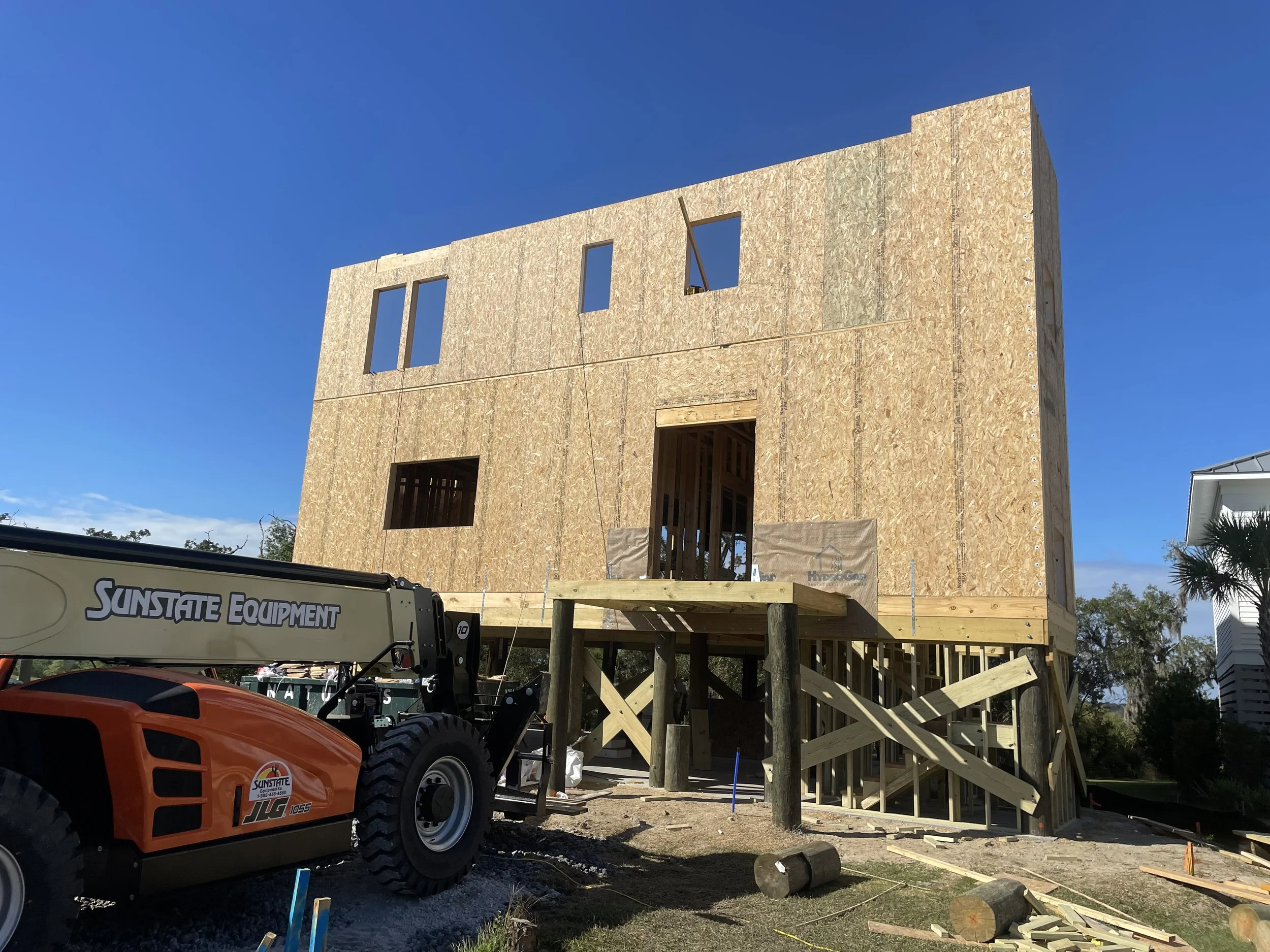
The Complete List of SIP Manufacturers in North America
A comprehensive, research-verified list of Structural Insulated Panel (SIP) manufacturers across North America. This guide helps builders, architects, and project teams understand the current SIP landscape and evaluate manufacturers based on system performance, materials, and code compliance.
By Joe Pasma, PE | PGS Consulting LLC, Licensed Professional Engineer | 40+ Years in SIP Engineering, Manufacturing, and Forensic Analysis
LAST UPDATED: APRIL, 2026
This list includes verified Structural Insulated Panel (SIP) manufacturers across the United States, Canada, and Mexico. Each company listed actively manufactures SIP panels, not just distributes or installs them.
How Many SIP Manufacturers Are in North America?
There are approximately 40 to 45 active Structural Insulated Panel (SIP) manufacturers across North America, including the United States, Canada, and Mexico. This includes manufacturers producing EPS, GPS, PUR/PIR, and MgO-based SIP systems.
Who Are the SIP Manufacturers in North America?
When builders, architects, or manufacturers reach out to PGS Consulting, one of the first questions is usually straightforward: Who actually manufactures Structural Insulated Panels in North America?
The SIP industry includes a mix of manufacturers, resellers, installers, and panelized builders. Many companies offer SIP packages or design services, but do not actually manufacture panels. That distinction matters when evaluating performance, code compliance, and system consistency.
Because the industry is relatively fragmented, publicly available lists are often incomplete, outdated, or include companies that are no longer producing SIPs.
How This SIP Manufacturer List Was Built
To provide a clearer picture of the industry, this list was developed through a combination of:
• SIPA member directory review
• ICC-ES and CCMC code report verification
• Manufacturer website validation
• Historical industry data
• Independent research and direct confirmation
The goal is simple: Provide a clean, manufacturer-only list. No resellers. No installers. No kit-only providers
Need Help Evaluating SIP Manufacturers?
Not all SIP manufacturers are the same, and the differences are not always obvious on the surface.
Joe Pasma, PE works with builders, manufacturers, and design teams to evaluate SIP systems based on engineering, manufacturing, and installation considerations.
If you are comparing manufacturers or trying to determine the best fit for your project, PGS Consulting can help bring clarity to the decision.
Learn more about PGS Consulting →
Complete List of SIP Manufacturers in North America (2026)
The table below includes verified SIP manufacturers across the United States, Canada, and Mexico. This list focuses on companies that actively produce Structural Insulated Panels. The table below lists SIP manufacturers across North America by location, core type, facing materials, and code compliance. On mobile, swipe left to view the full table.
This list is updated regularly to reflect active SIP manufacturers and current code compliance data.
| SIP Manufacturer | City, State | Inception | Core Type | Facing Type | Website | SIPA Member | Code Report |
|---|---|---|---|---|---|---|---|
| ACME Panel | Radford, VA | 2009 | EPS, GPS | OSB | acmepanel.com | Yes | ICC-ES ESR-4690 Valid through 04-2026 |
| Alaskan Insulated Panels | Wasilla, AK | ~2005 | PUR | OSB | alaskainsulatedpanels.com | No | No |
| APEX SIPs | Tulsa, OK | 2000 | EPS | OSB | apexsips.com | No | No |
| Big Sky R-Control SIPs | Belgrade, MT | 1977 | EPS | OSB | bigskyrcontrol.com | No | ICC-ES ESR-2233 ICC-ES ESR-4782 |
| Eagle Panel Systems | Mulberry Grove, IL | 1996 | EPS | OSB | eaglepanelsystems.com | No | No |
| Ecopan | Alberta, Canada | 1991 | EPS | OSB | sipstech.com | No | ICC-ES ESR-4159 |
| EcoPanels | Mocksville, NC | 2007 | PUR | ZIP OSB, OSB, Plywood | eco-panels.com | No | No |
| EcoPanels of TN | Hermitage Springs, TN | 2019 | PUR | ZIP OSB | ecopanelsoftn.com | No | No |
| Enercept | Watertown, SD | 1982 | EPS | OSB | enercept.com | Yes | ICC-ES ESR-4693 |
| Energy Panel Structures | IA / MO | ~1986 | EPS | OSB | epsbuildings.com | Yes | ICC-ES ESR-4697 |
| EnerSIP | Manitoba, Canada | 2000 | EPS | OSB | enersip.com | No | CCMC 13016-R |
| Extreme Panel Technologies | Minnesota | 1992 | EPS, GPS | OSB | extremepanel.com | Yes | ICC-ES ESR-4524 |
| FischerSIPS | Louisville, KY | 1986 | EPS | OSB | fischersips.com | Yes | ICC-ES ESR-4694 |
| Foam Laminates | Vermont | 1982 | EPS, GPS | OSB | foamlaminates.com | No | IAPMO UES 786 |
| Foard Panel | New Hampshire | 1985 | EPS, GPS, PIR | OSB | foardpanel.com | Yes | ICC-ES ESR-4691 |
| Greenix Panels | Georgia | 2003 | PUR | OSB, MgO | greenixpanels.com | No | No |
| ICS Eco-SIPS | Colorado | 2004 | PUR | OSB | ics-rm.com | No | No |
| InGreen Building Systems | Alberta, Canada | 2016 | EPS | OSB | ingreensystems.com | Yes | No |
| Innova Panel | Florida | - | EPS | MgO | innovapanel.com | No | No |
| Insulspan | Michigan | - | EPS, GPS | OSB | insulspan.com | Yes | ICC-ES ESR-1295 |
| Lamit by Armstrong | Ohio | - | EPS | OSB | armstrongceilings.com | Yes | No |
| MagWall | Alberta, Canada | 2008 | EPS | MgO | magwall.com | No | No |
| Murus | Pennsylvania | 1987 | EPS, GPS, PUR | OSB | murus.com | Yes | ICC-ES ESR-4784 |
| OMC Panels | Alberta, Canada | - | EPS | Plywood | omcpanels.com | No | No |
| Porter | Michigan | 1964 | EPS | OSB | portersips.com | Yes | ICC-ES ESR-4692 |
| Preflex | Mexico | - | EPS | OSB | preflexinc.com | Yes | ICC-ES ESR-5318 |
| Premier SIPs | MT / WA | 1977 | EPS, GPS | OSB | premiersips.com | Yes | ICC-ES ESR-4524 |
| Prestige Panel Solution | Quebec, Canada | 2005 | PUR | OSB | prestigepanelsolution.com | No | ? |
| RAY-CORE SIPs | Idaho | 1987 | PUR | Foil | raycore.com | No | No |
| R-Control SIPs | Texas | - | EPS | OSB | rcontrolsips.com | Yes | ICC-ES ESR-4780 |
| Branch River Plastics | Rhode Island | - | EPS | OSB | branchriver.com | Yes | ICC-ES ESR-4780 |
| sPanels | Idaho | - | EPS | OSB | spanels.com | No | ICC-ES ESR-2182 |
| S-Panels Omaha | Nebraska | - | EPS | OSB | spanelomaha.com | No | No |
| SIPS of America | Missouri | - | PUR | OSB | sipsofamerica.com | No | No |
| Structural Panel Innovations | Kansas | - | EPS | OSB | structuralpanelinnovations.com | No | No |
| Thermapan | Ontario, Canada | 1980 | EPS | OSB | thermapan.com | No | No |
| Thermocore | Indiana | - | PUR | OSB | thermocore.com | No | ICC-ES ESR-4525 |
| Urban Industries | Ohio | - | EPS | OSB | urbanindustries.com | Yes | ICC-ES ESR-4695 |
| ZS2 Technologies | Alberta, Canada | - | EPS | MgO | zs2technologies.com | Yes | ICC-ES ESR-5346 |
While this list is comprehensive, project requirements, code approvals, and system capabilities can vary. Always verify details directly with the manufacturer for your specific project.
Understanding SIP Core Types
Not all Structural Insulated Panels are built the same. While the concept of SIP construction is consistent, manufacturers differentiate themselves through the type of insulation core and facing materials used. These choices directly affect thermal performance, structural behavior, cost, and how the system performs in different environments.
Understanding the core types is one of the first steps in evaluating SIP manufacturers.
EPS (Expanded Polystyrene)
EPS is the most widely used core material in the SIP industry.
It is cost-effective, stable, and broadly recognized within building codes. EPS-based SIPs are commonly used across residential and light commercial construction due to their balance of performance and affordability.
EPS systems are also well understood by most design and construction teams, which can simplify both engineering and installation.
GPS (Graphite Polystyrene)
GPS is a modified version of EPS that includes graphite to improve thermal performance.
This results in a higher R-value per inch compared to standard EPS. GPS is often used in projects where improved energy performance is a priority but where the overall system approach remains similar to EPS construction.
Not all manufacturers offer GPS, so availability can vary.
PUR / PIR (Polyurethane-Based Systems)
PUR and PIR SIPs offer higher thermal performance and tighter manufacturing tolerances.
These systems are often used in projects that require increased insulation performance or more controlled manufacturing conditions. PUR/PIR panels can also offer different structural and bonding characteristics compared to EPS-based systems.
However, they are typically produced by a smaller group of manufacturers and may be more expensive.
MgO-Faced SIPs
MgO (magnesium oxide) faced SIPs are a growing category within the industry.
Instead of traditional OSB facings, these panels use MgO boards, which offer different fire resistance and moisture performance characteristics. These systems are often selected for specific applications where non-combustibility or durability is a priority.
As with any system, proper engineering and installation are critical to performance.
The choice of core type should always be evaluated in the context of the full building system, not as a standalone product decision.
How to Choose the Right SIP Manufacturer
Selecting a Structural Insulated Panel (SIP) manufacturer is not just a product decision. It is a system decision that affects engineering, manufacturing, installation, and long-term building performance.
While many manufacturers offer similar panel types, the differences in how those panels are designed, produced, and supported can significantly impact project outcomes.
Here are the key factors to evaluate:
Core Type and Performance Requirements
Start with the insulation core.
Most SIP manufacturers produce panels using one or more of the following:
• EPS (expanded polystyrene)
• GPS (graphite polystyrene)
• PUR or PIR (polyurethane-based systems)
• MgO-faced panel systems
Each core type offers different performance characteristics related to R-value, moisture behavior, fire resistance, and cost. The right choice depends on your climate, building type, and performance goals.
Code Compliance and Engineering Support
Not all SIP systems are evaluated the same way.
Look for manufacturers with:
• ICC-ES or CCMC code reports
• third-party testing and validation
• documented structural and thermal performance
Equally important is the level of engineering support provided. A strong manufacturer will help align panel design with structural loads, spans, and project requirements.
Manufacturing Quality and Consistency
SIP performance starts in the factory.
Differences in manufacturing processes, quality control systems, and material handling can affect:
• panel dimensional accuracy
• bond strength
• long-term durability
Consistent production is critical, especially for projects with tight tolerances or complex geometries.
Installation Considerations
Even the best panel system can underperform if installation is not aligned with the design.
Evaluate:
• panel layout and sequencing
• connection details
• sealing methods
• field documentation and guidance
Manufacturers that provide clear installation documentation and support help reduce errors, delays, and performance issues.
Project-Specific Requirements
Every project is different. The right SIP manufacturer should align with:
• climate zone
• building type
• structural requirements
• construction schedule
• installation experience of the team
There is no single “best” manufacturer. The right choice is the one that fits the system requirements of your specific project.
PGS Consulting frequently works with SIP manufacturers, builders, and design teams to evaluate building system performance, manufacturing processes, and installation practices.
Frequently Asked Questions About SIP Manufacturers
1. How many SIP manufacturers are there in North America?
There are roughly 40–45 active SIP manufacturers across the U.S., Canada, and Mexico, depending on how you classify MgO‑faced and hybrid panel producers. Our list includes only true manufacturers, not resellers or installers, so readers get an accurate picture of the actual production landscape.
2. Why do some companies claim to make SIPs but aren’t on this list?
Many companies in the SIP space are installers, kit providers, or resellers, not manufacturers. They may market “SIP packages,” but the panels themselves are produced by a third‑party manufacturer. This list includes only companies that physically manufacture SIPs.
3. What’s the difference between EPS, GPS, and PUR/PIR SIP manufacturers?
Each manufacturer specializes in one or more core types:
EPS — Most common, cost‑effective, widely code‑recognized
GPS — Higher R‑value per inch, used by a smaller group of manufacturers
PUR/PIR — Higher performance, tighter tolerances, fewer manufacturers
MgO‑faced SIPs — A growing category with unique fire and moisture characteristics
Your choice of manufacturer often depends on performance goals, code requirements, and project complexity.
4. Are all SIP manufacturers members of SIPA?
No. SIPA membership is voluntary. Many reputable manufacturers are SIPA members, but several long‑standing producers are not. SIPA membership is a helpful indicator of industry engagement, but not a requirement for quality or code compliance.
5. How do I choose the right SIP manufacturer for my project?
Start with three filters:
Core type — EPS, GPS, PUR/PIR, or MgO
Code report — ICC‑ES, CCMC, or third‑party engineering
Project needs — spans, loads, climate zone, installation workflow
Evaluating SIP Manufacturers for Your Next Project
If you are comparing SIP manufacturers or trying to understand how different systems will perform in your project, PGS Consulting can help.
Joe Pasma, PE brings more than 40 years of experience across SIP engineering, manufacturing, installation, and forensic investigation.
About the Author
Joe Pasma, PE is a licensed professional engineer with more than 40 years of experience working with Structural Insulated Panels and advanced building systems. His background includes structural engineering, manufacturing operations, installation oversight, and forensic investigation.
Through PGS Consulting LLC, Joe works with manufacturers, builders, architects, building owners, and project teams to improve technical systems, reduce risk, and strengthen building performance.
Can Structural Insulated Panels (SIPs) Be Used in Moist or Cold Climates?
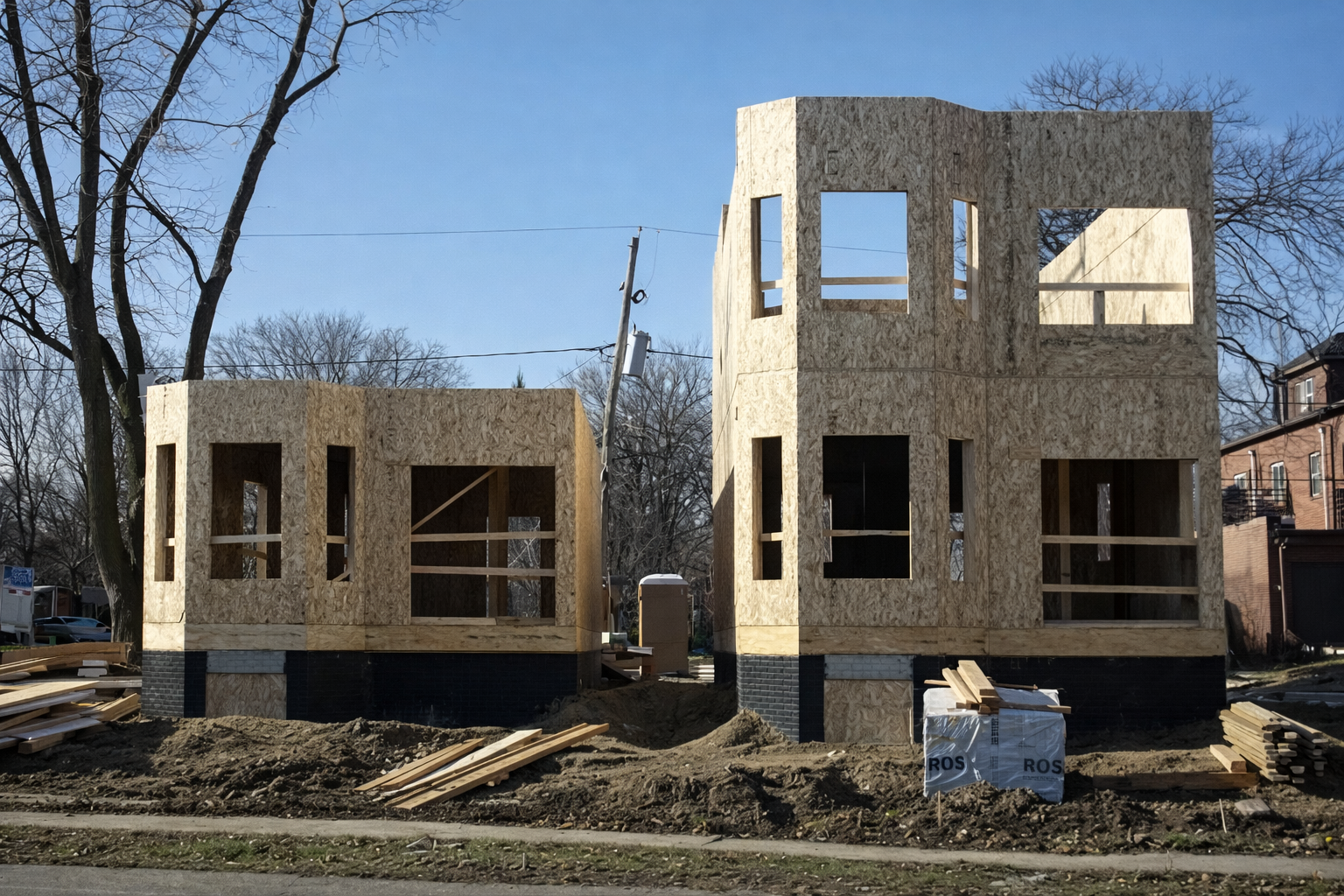
Structural Insulated Panel (SIP) building under construction, showing panelized wall and roof assembly during installation.
Editor’s Note: This article is adapted from an “Ask the Expert” column originally written by Joe Pasma, PE, and published in Facility Magazine in 2013. The content has been updated to reflect current building practices and industry context.
Structural Insulated Panel (SIP) building under construction, showing panelized wall assembly during installation.
One of the most common questions people ask about Structural Insulated Panels is whether they can be used in wet, humid, or cold climates.
The real question behind that concern is much simpler: Can you safely build with wood in these climates?
The answer has always been yes.
Wood-framed buildings exist everywhere from the Louisiana Gulf Coast to communities above the Arctic Circle in Alaska. Structural Insulated Panels use the same fundamental materials, but combine them into a high-performance panelized building system.
When properly designed and installed, SIPs perform extremely well in demanding climates.
SIP Construction in Challenging Climates
Across North America, there are many examples of successful SIP buildings located in cold, wet, and humid environments.
Examples include:
• George Morgan High School in Kalskag, Alaska, where the region receives heavy snowfall and regularly experiences sub-zero temperatures
• Cody Cattle Company restaurant in northern Wyoming near Yellowstone National Park
• Little Big Horn College Health and Wellness Center on the plains of Montana
• Finn Hill Junior High School in Kirkland, Washington, an area that receives nearly 40 inches of rain annually
• Portland Community College Newberg Center in Oregon, recognized as an AIA Committee on the Environment Top Ten Green Project
These projects demonstrate that SIP construction can perform reliably in climates where moisture control and durability are critical.
Why People Question SIPs in Moist Climates
The concern usually centers around the oriented strand board (OSB) skins used in SIP panels.
Because OSB is a wood-based material, some assume it may be vulnerable to moisture.
In reality, SIP panels are manufactured using OSB with an Exposure 1 rating under APA standards. This rating means the adhesive bonds are designed to withstand temporary exposure to moisture during construction before the building is fully enclosed.
This is the same type of rating used in many conventional wood framing materials.
Like any building system, the long-term durability of SIPs depends on proper building envelope design and installation practices.
Moisture Management Still Matters
Whether a building is framed with studs or panels, controlling water and air movement is essential.
The International Building Code requires several components that protect the building envelope from moisture intrusion:
• Proper flashing at windows, doors, and penetrations
• A weather-resistant barrier to protect the wall assembly
• Drainage pathways that allow water to exit the wall system
These practices apply equally to SIP construction.
For SIP walls, builders typically use synthetic weather barriers or building wraps as the weather-resistant barrier.
For roof assemblies, breathable roofing underlayments often replace traditional felt paper. These materials allow water vapor to escape while keeping bulk water out, similar to how a high-quality rain jacket works.
This can be particularly beneficial if SIP roof panels experience temporary exposure during construction.
Read more about the relationship between air control, moisture management, and building envelope performance in an article published in The Construction Specifier.
Air Sealing Is a Major Advantage of SIPs
One reason SIPs perform so well in demanding climates is their airtight construction.
The panels contain continuous insulation and fewer joints than conventional framing systems. When the panel joints are properly sealed with mastics and tapes, the building envelope becomes extremely tight.
This helps prevent warm, humid air from entering wall and roof cavities where condensation can occur.
In many climates, building codes may also require a vapor retarder depending on the wall assembly and local conditions. Builders should always confirm requirements with the local building official and SIP manufacturer.
A Quick Word for Builders Evaluating SIP Construction
SIPs are sometimes viewed as a futuristic or unfamiliar technology. In reality, the system has been studied extensively and used successfully for decades.
The primary reasons builders choose SIPs typically come down to two practical benefits:
Energy efficiency and construction speed.
Because SIPs provide continuous insulation and exceptional airtightness, they can significantly reduce heating and cooling energy use. Studies from the U.S. Department of Energy have shown SIP buildings can dramatically outperform conventional framing in air leakage and thermal performance.
SIPs also streamline construction. Panels arrive pre-cut and labeled, allowing crews to assemble walls and roofs much faster than traditional framing.
This can be especially valuable in an industry facing ongoing labor shortages.
Have questions about using SIPs on a project?
If you have questions about SIP construction or panelized building systems, feel free to reach out. Joe is always glad to help teams think through the technical considerations that affect project performance.
The Bottom Line
Structural Insulated Panels can perform very well in wet, cold, or humid climates when the building envelope is properly designed and installed.
The same principles that protect conventional wood framing also apply to SIP construction. Proper flashing, weather barriers, drainage, and air sealing ensure the building remains durable and efficient over the long term.
When these practices are followed, SIPs offer a strong combination of durability, energy efficiency, and construction speed that continues to attract builders, architects, and facility owners across North America.
Frequently Asked Questions About SIPs in Moist Climates
Can Structural Insulated Panels be used in humid climates?
Yes. SIP buildings perform well in humid climates when the building envelope is properly designed and installed. Proper flashing, weather barriers, and sealed panel joints prevent moisture intrusion and air leakage.
Do SIP panels absorb water?
SIP panels use oriented strand board (OSB) skins that are manufactured with an Exposure 1 rating under APA standards. This rating allows for temporary exposure to moisture during construction before the building is fully enclosed.
Like any wood-based building material, long-term durability depends on proper moisture management in the building envelope.
Are SIP roofs suitable for rainy climates?
Yes. SIP roof systems are commonly used in regions with heavy rainfall or snow. Breathable roofing underlayments help protect the roof assembly while allowing water vapor to escape.
Are SIP buildings more airtight than traditional framing?
Yes. SIP panels have continuous insulation and fewer joints than conventional framing systems. When the panel joints are properly sealed, SIP structures can achieve very high levels of airtightness, which improves energy efficiency and building durability.
Do SIP buildings work in cold climates?
SIPs are widely used in cold climates because they provide excellent insulation and airtightness. Many buildings in northern regions of North America use SIP construction to reduce heating energy consumption and improve indoor comfort.
Have Questions About SIP Construction?
If you are exploring Structural Insulated Panels or evaluating panelized construction for a project, Joe Pasma, PE is always glad to help. With more than 40 years of experience across engineering, manufacturing, installation, and forensic investigation, Joe provides practical guidance to help project teams avoid costly mistakes and build better-performing structures.
About the Author
Joe Pasma, PE, is a licensed professional engineer with more than 40 years of experience working with Structural Insulated Panels and advanced building systems. His background spans structural engineering, manufacturing systems, installation oversight, and forensic investigation.
Through PGS Consulting LLC, Joe advises manufacturers, builders, architects, building owners, and project teams on the technical and operational challenges associated with high-performance building systems.
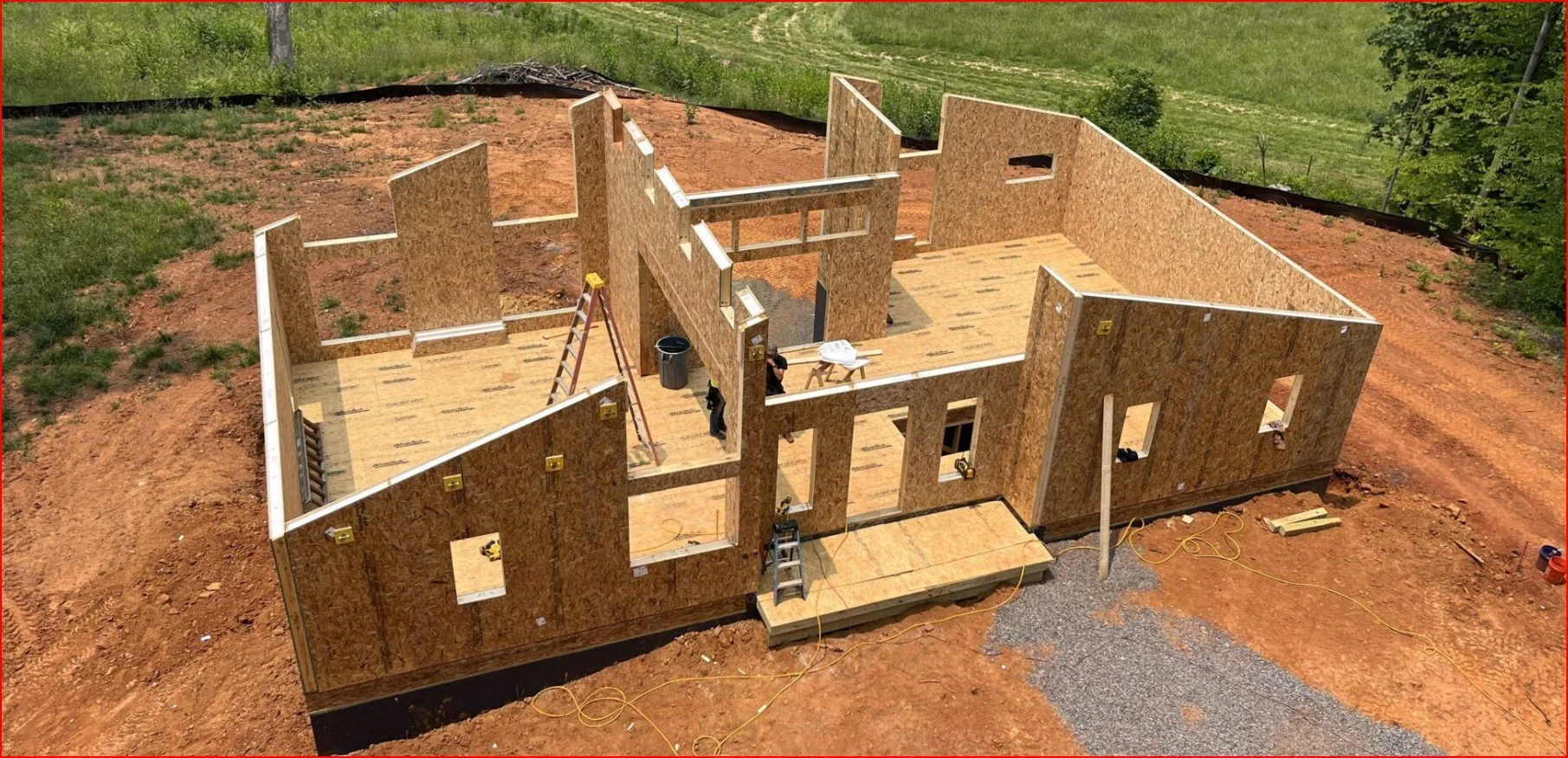
Why Structural Insulated Panels (SIPs) Create Faster, More Energy Efficient Building Envelopes
Why Structural Insulated Panels (SIPs) Create Faster, More Energy Efficient Building Envelopes
Editor’s Note: This article is adapted from an article originally written by Joe Pasma, PE, and published in Green Homebuilder in 2015. The content has been updated to reflect current building practices and industry context.
For most residential construction in the United States, stick framing has long been the standard approach. Builders understand it, materials are widely available, and the process is familiar across the industry.
At the same time, the expectations placed on buildings today have changed. Energy codes are stricter, labor shortages are affecting job sites, and builders are under increasing pressure to deliver homes that perform better and waste less energy.
Because of these changes, more builders are exploring advanced building envelope systems such as Structural Insulated Panels, commonly known as SIPs.
SIPs combine structure and insulation into a single panel system. When designed and installed correctly, they simplify the building envelope while improving performance and construction efficiency.
Builders often discover that SIPs solve several problems at the same time. They help create tighter buildings, improve insulation performance, and speed up the framing stage of construction.
Key Takeaways: Why Builders Use SIP Building Envelopes
• SIPs create tighter building envelopes because they reduce the number of joints where air leakage can occur.
• Continuous insulation across the panel reduces thermal bridging that occurs with traditional framing.
• Factory-manufactured panels allow builders to install walls and roofs significantly faster.
• Pre-cut openings and integrated electrical chases simplify construction.
• Reduced framing labor helps address the skilled labor shortages affecting the construction industry.
• Improved airtightness and insulation can reduce heating and cooling demand.
Why Airtightness Matters in Building Performance
One of the biggest advantages of SIP construction is airtightness.
Energy codes across the United States continue to place greater emphasis on controlling air leakage. Air that moves uncontrolled through a building envelope carries heat, moisture, and energy costs with it.
For example, California’s Title 24 Building Energy Efficiency Standards require that joints, penetrations, and openings in the building envelope be sealed to limit infiltration and exfiltration.
Similarly, the International Energy Conservation Code (IECC) requires blower door testing to verify air tightness in residential construction.
Meeting these air leakage targets with traditional framing is possible, but it requires careful detailing and significant attention during construction.
SIP construction simplifies the process.
Because SIP walls consist of continuous insulation sandwiched between structural facings, there are fewer joints and fewer pathways for air to move through the wall assembly. When the panels are sealed properly during installation, the building envelope becomes much easier to tighten.
Research from Oak Ridge National Laboratory
Research from the U.S. Department of Energy’s Oak Ridge National Laboratory (ORNL) has demonstrated how airtight SIP construction can be.
Testing conducted by ORNL found that SIP structures can be significantly more airtight than traditionally framed walls insulated with fiberglass batts.
Research like this highlights one of the key benefits of SIP construction. Fewer joints and simpler wall assemblies make it easier to create a tight building envelope.
For homeowners, that typically means lower heating and cooling demands and a more comfortable indoor environment.
Whole Wall Performance Matters
Another important difference between SIP construction and traditional framing involves how insulation performance is measured.
Many discussions about insulation focus on the R value of the insulation material itself. In reality, what matters most is the performance of the entire wall assembly.
Traditional framing introduces thermal bridges through studs, plates, and headers. Heat moves through those structural members much more easily than it moves through insulation.
SIPs reduce this problem because the insulation layer is continuous across the panel.
Because there are fewer framing interruptions, the insulation performs closer to its intended value across the entire wall.
For builders and homeowners, that means a building envelope that holds conditioned air more effectively and reduces heating and cooling demand.
Thinking about using SIPs on a project?
If you are evaluating Structural Insulated Panels or exploring panelized construction, Joe is always happy to talk through the technical considerations and help teams understand their options.
Why SIP Construction Speeds Up the Framing Process
In addition to energy performance, SIP construction can significantly reduce framing time.
Panels are manufactured off-site and delivered to the jobsite pre-cut according to the project plans. Window and door openings are typically cut during manufacturing, and electrical chases are often built into the panels.
Instead of assembling walls one stud at a time, crews install large structural panels that can span several feet in both directions.
Entire wall and roof sections can often be installed in hours rather than days.
Builders often describe the process as assembling a structure like a puzzle. Each panel is labeled and corresponds to a specific location in the building.
This approach reduces on-site cutting, limits jobsite waste, and helps construction crews move through the framing stage more efficiently.
Addressing the Skilled Labor Shortage
Labor shortages continue to affect construction projects across the United States.
Traditional framing requires crews to measure, cut, and assemble large quantities of lumber on site.
SIP construction reduces much of that complexity.
Because the panels arrive ready for installation, crews spend less time performing repetitive framing tasks. Openings are already cut, and the structural and insulation components are combined into a single system.
This does not eliminate the need for skilled tradespeople, but it can significantly reduce the amount of labor required to complete the framing stage of a project.
For many builders, this efficiency is becoming just as important as the energy performance advantages.
What Builders Should Know About Cost
Builders often ask whether SIP construction costs more than traditional framing.
The answer depends on how the project is evaluated.
Panel materials may cost more than the lumber used in stick framing. However, when labor savings, shorter construction timelines, and reduced jobsite waste are considered, the overall project cost is often comparable.
A tighter building envelope can also enable smaller heating and cooling systems, potentially reducing mechanical equipment costs.
Over the life of the building, improved insulation and airtightness can also reduce energy expenses for homeowners.
For many projects, the conversation shifts from the cost of materials to the value of the complete building system.
A Systems Approach to Building Performance
One of the most important lessons from working with SIP systems over many years is that building performance rarely depends on a single component.
Performance depends on how the entire system works together.
When SIP panels are properly designed, manufactured, and installed, they offer a straightforward way to build strong, energy-efficient building envelopes with fewer complications during construction.
That combination of simplicity and performance is one reason many builders continue to explore SIP systems as a practical alternative to conventional framing methods.
Frequently Asked Questions About SIP Building Envelopes
Are SIP buildings more airtight than stick-framed homes?
Yes. Research from the U.S. Department of Energy’s Oak Ridge National Laboratory has shown that SIP structures can be significantly more airtight than traditionally framed walls because there are fewer joints and gaps where air can leak through the building envelope.
Do SIPs install faster than traditional framing?
In many projects, they do. SIP panels are manufactured off-site and delivered to the jobsite pre-cut according to the construction drawings. Large structural panels allow crews to assemble walls and roofs much faster than building them piece by piece with traditional framing.
Do SIPs cost more than stick framing?
Panel materials may cost more than traditional lumber, but overall project costs are often similar when labor savings, shorter construction schedules, and reduced waste are considered.
Why do builders choose SIP construction?
Builders often choose SIPs because they provide a strong, well-insulated building envelope that installs quickly and performs well under modern energy code requirements.
Discussing a SIP Project
If you are exploring Structural Insulated Panels or evaluating panelized construction for a project, feel free to reach out. I’m always glad to help teams think through the engineering, manufacturing, and installation considerations that can affect project performance.
About the Author
Joe Pasma, PE is a structural engineer with more than 40 years of experience working with Structural Insulated Panels, advanced building systems, manufacturing processes, and forensic investigations. Through PGS Consulting LLC, he provides advisory support to manufacturers, builders, architects, building owners, and project teams navigating complex building system decisions.