
Step 1
Intake and document review
Plans, shop drawings, engineering calculations, installation photos, weather history

SIP panel failures rarely have a single cause. Learn what SIP forensic analysis is, when to use it, and what a real investigation looks like -- from a licensed PE with 40+ years of SIP experience.
By Joe Pasma, PE | PGS Consulting LLC, Licensed Professional Engineer | 40+ Years in SIP Engineering, Manufacturing, and Forensic Analysis | Published June 12, 2026
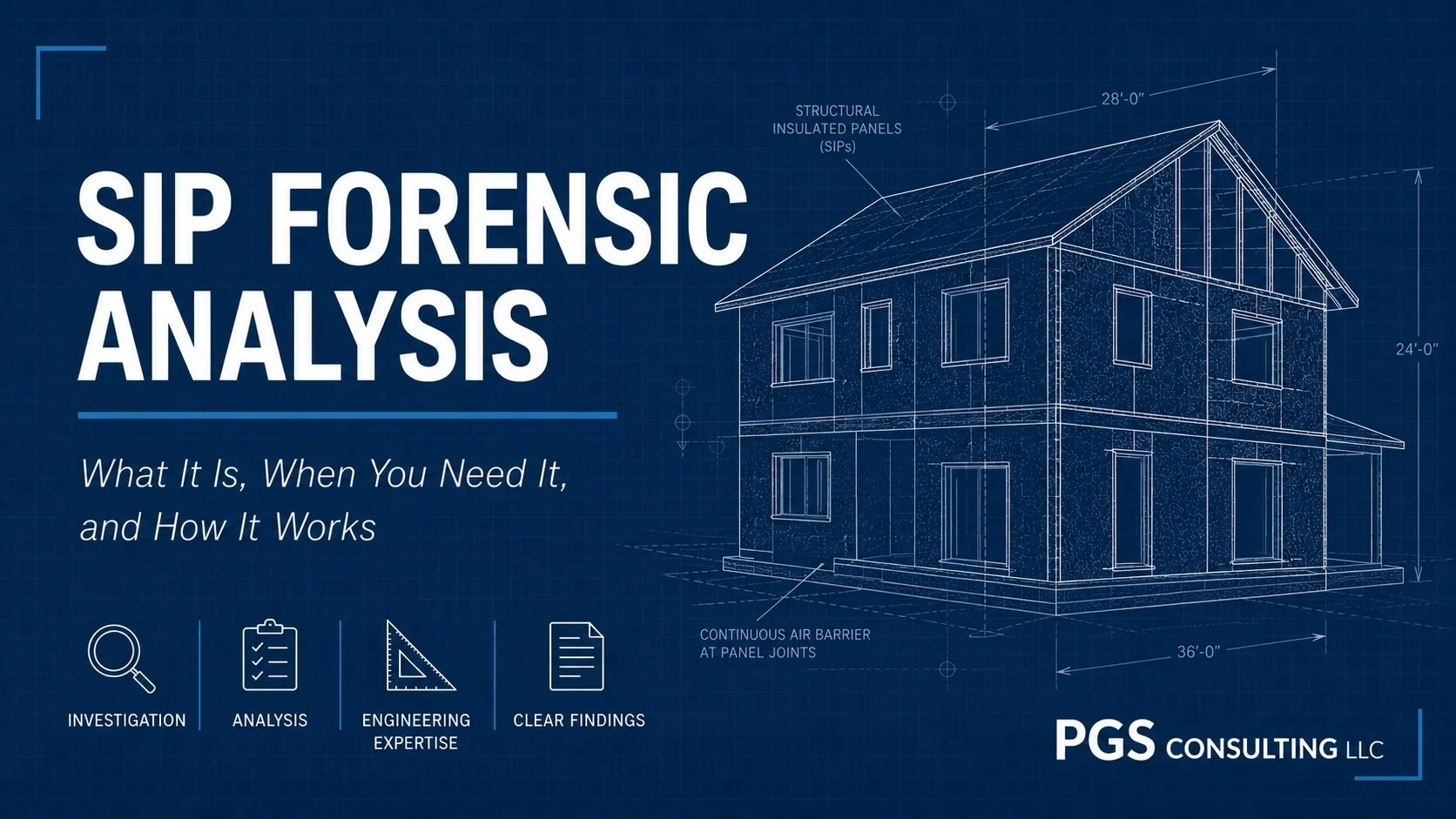
Something went wrong with your SIP building or you think something maybe wrong. Maybe it's a smell. Maybe it's a stain. Maybe it's a dispute between the builder and the manufacturer, and nobody agrees on what actually happened.
You don't need someone to guess. You need answers.
SIP forensic analysis is the structured process of figuring out exactly why a SIP system failed, what contributed to it, and what to do next. It replaces assumptions -- and the expensive decisions that come with them -- with documented, defensible findings.
Here's what it involves, when it makes sense to use it, and what you can expect from the process.
SIP forensic analysis is an evidence-based investigation of why a SIP assembly failed -- not an attempt to assign blame.
Most SIP failures involve more than one contributing factor -- detailing, installation, moisture management, or design mismatches working against each other.
A forensic investigation follows a clear, predictable process: document review, field investigation, failure analysis, root cause determination, and corrective action recommendations.
The end product is a defensible written report that can be used by builders, designers, insurers, attorneys, and owners.
If there is uncertainty, disagreement, or legal exposure involved, forensic analysis is the most efficient path to resolution.
SIP forensic analysis is a structured, evidence-based engineering investigation that identifies why a structural insulated panel assembly failed, determines the root cause and contributing factors, and produces a defensible written report for use in repairs, disputes, insurance claims, or legal proceedings.
It might be triggered by leaks, odors, rot, panel movement, delamination, or performance issues that don't have an obvious explanation. The investigation looks at what happened, why it happened, and what conditions allowed it to happen.
It is not about assigning blame. It is about understanding the chain of events that led to the issue or failure -- so the right corrective action can be taken, and the same problem doesn't repeat.
A complete forensic analysis covers:
Document review -- plans, shop drawings, engineering calculations, installation photos, and warranties
Field investigation -- moisture readings, blower door testing, thermal imaging, borescope inspection, core sampling, and physical cut-outs
Failure mode identification -- the specific mechanism that failed, whether that's moisture intrusion, air leakage, thermal bypass, or an installation error
Root cause analysis -- the underlying reason the failure occurred, not just the visible symptom
Contributing factor analysis -- sequencing errors, maintenance gaps, design details that didn't translate to the field
Corrective action recommendations -- what to fix, how to fix it, and how to prevent it from happening again
The goal is clarity.
Most people call when they notice symptoms. But symptoms are rarely the whole story.
Common triggers include:
Moisture staining or active leaks
Musty odors or indoor air quality problems
OSB that has softened or started to rot
Roof panel sagging or unexpected deflection
Shingles missing from the roof without high wind activity
Delamination concerns in the panel assembly
Electrical chases or plumbing cutouts that were never properly sealed
Disputes between a builder, designer, or manufacturer about what went wrong
Insurance claims or legal proceedings that require an independent technical opinion
If a situation involves uncertainty, disagreement, or financial or legal risk, forensic analysis is the cleanest path to resolution. It gives every party a common set of facts to work from.
For a grounding in common SIP failure patterns before deciding on next steps, see SIP Problems and Failures.
The process follows a clear, transparent workflow. There are no surprises about what happens or why.
The investigation starts with gathering everything that describes the building as it was supposed to be built.
This includes plans, engineering documents, shop drawings, installation photos, weather history during construction, and any maintenance records. This establishes the intended system -- the baseline against which field conditions are compared.
This is where the actual story starts to emerge.
Depending on what the document review reveals (Step 1), a field investigation might include moisture mapping across the assembly, blower door testing, thermal imaging to identify air leakage or thermal bridging, borescope inspection to look inside panel cavities without destructive removal, core sampling to assess OSB condition and bonding of SIP components, strategic cut-outs at locations most likely to show failure, and air leakage diagnostics.
The field investigation is matched to the specific problem. Not every investigation requires every technique.
Most SIP failures fall into a predictable set of categories:
Moisture Intrusion and OSB Deterioration
Air leakage at splines, connections, or unsealed gaps
Roof Ridge and Beam Interface Failures
Incorrect Structural Design or Load Path
HVAC and Mechanical Integration Failures
Poor Installation Practices
Manufacturer Quality Control and Fabrication Errors
Identifying the failure mode answers the question: what failed?
This is the core of the work.
Root cause analysis answers the harder questions: why did it fail, what conditions allowed it to fail, and could it have been prevented? It looks past the symptom to the underlying mechanism.
This is the part of the investigation that makes the findings defensible -- and that tells you whether a repair will actually solve the problem, or just cover it up.
Recommendations are technically grounded, risk-based, and cost-aware. They take into account manufacturer requirements and the realistic scope of repair options available to the building owner.
Depending on findings, recommendations might include localized repairs, panel section replacement, joint reconstruction, improved moisture management details, or a monitoring plan to track conditions going forward.
The goal is to match the corrective action to the actual cause -- not to over-repair or under-repair based on assumptions.
A forensic report is a complete, defensible document -- one that can hold up in a construction dispute, an insurance claim, or a legal proceeding.
It is written to be understood by builders, designers, manufacturers, insurers, attorneys, and building owners -- not just engineers.
A complete report includes:
Executive summary with key findings and recommendations
Chronology of construction events
Document review findings
Field investigation results with photos, measurements, and diagrams
Failure mode analysis
Root cause determination
Contributing factors
Corrective action recommendations
Appendices with supporting documentation
This is the document that turns uncertainty into clarity -- and that gives every party involved a shared, factual foundation for moving forward.
SIP failures are almost never caused by a single factor.
They are typically the result of multiple system factors working against each other -- detailing decisions, installation sequencing, moisture management choices, field modifications, environmental exposure combining in ways that no single party anticipated.
That's exactly why forensic analysis matters. It identifies not just what failed, but the full chain of events that led to the failure. Without that understanding, repairs address symptoms without fixing causes, and disputes drag on without resolution.
Understanding how a SIP assembly is supposed to be designed and detailed in the first place is foundational context for any forensic investigation. The SIP Installation Guide and SIP Building Codes and Compliance pages in the resource hub cover the standards and practices that provide the basis of SIP forensic evaluation.
A thorough forensic analysis:
Reduces uncertainty for everyone involved
Clarifies where responsibility lies
Prevents the same failure from recurring
Protects the building owner's investment
Protects the builder from unfounded claims
Protects the manufacturer's position
Gives insurers and attorneys the documentation they need
It is the most efficient way to move from confusion to resolution.
If you are dealing with a SIP problem and need an independent, experienced opinion, Joe Pasma, PE is available for forensic consulting engagements. Contact Joe to discuss your situation.
SIP forensic analysis is a structured investigation into why a structural insulated panel assembly failed. It reviews documents, conducts field testing, identifies the failure mode, determines the root cause, and produces corrective action recommendations. The result is a defensible written report that can be used in repairs, disputes, insurance claims, or legal proceedings.
Common triggers include moisture staining, musty odors, OSB deterioration or softening, panel deflection or sagging, delamination, disputes between builders, designers, or manufacturers. Legal and insurance reviews are also common reasons to commission a SIP forensic analysis.
An inspection is a visual or instrument-based assessment of current conditions. A forensic analysis goes further -- it identifies issues, possible failure modes, traces the root cause, assesses contributing factors, and produces a documented, defensible report. A forensic analysis is appropriate when the stakes involve disputes, legal exposure, or significant corrective action decisions.
SIP forensic reports are used by building owners, builders, designers, manufacturers, insurance adjusters, and attorneys. The report provides a common factual foundation that all parties can reference, which typically shortens disputes and clarifies repair decisions.
The timeline depends on the complexity of the building, the extent of the suspected issues or failure, and document availability. Simple investigations can be completed in a few days or weeks. Complex multi-system failures or situations involving significant documentation may take longer. A clear scope and timeline can be established at intake.
Yes. A well-documented forensic report that identifies the failure mode, root cause, and contributing factors gives insurance adjusters the technical basis they need to evaluate a claim. It also protects building owners from having claims denied due to unclear or undocumented causes.
Look for a licensed professional engineer with direct SIP experience that spans design, manufacturing, installation, and failure investigation. General construction knowledge is not sufficient -- SIP systems have specific characteristics that require hands-on familiarity with how they are engineered, manufactured, and built.
Joe Pasma, PE is a licensed professional engineer and the founder of PGS Consulting LLC in White Bear Lake, Minnesota. He has spent more than 40 years working directly in SIP engineering, manufacturing operations, installation oversight, and forensic analysis. Joe has worked with SIP manufacturers, builders, designers, and legal teams across the country -- including cases involving fire performance, building failures, and code compliance disputes.
He is one of a small number of engineers in the United States with deep, hands-on experience across the full SIP lifecycle. Learn more about Joe Pasma, PE.