

Are SIPs Combustible? Fire Performance, Codes, and What Actually Keeps You Safe
Are SIPs combustible? Yes -- but that doesn't mean unsafe. Learn how OSB and EPS behave in fire, what the building code requires, and why properly installed SIP assemblies perform predictably and safely.
By Joe Pasma, PE | PGS Consulting LLC, Licensed Professional Engineer | 40+ Years in SIP Engineering, Manufacturing, and Forensic Analysis | Published June 11, 2026, Updated September 13, 2026
It's one of the first questions I hear from people seriously considering SIP construction: "Wait -- isn't that foam? Doesn’t it burn?"
Yes. SIPs contain combustible materials. Both the OSB skins and the foam core will burn. I'm not going to sugarcoat that.
But here's the part that most articles skip over: combustible does not mean unpredictable. It does not mean unsafe. And it does not mean SIPs perform worse in a fire than traditional stick framing.
Fire safety in construction is never about a single material. It's about the whole assembly -- how the pieces work together, what barriers are in place, and whether everything was installed correctly. SIP assemblies are among the most thoroughly tested, tightly regulated, and predictable systems in residential construction today.
This article walks through what "combustible" actually means, how the materials in SIPs behave when exposed to fire, what the building code requires, and what real-world fire performance looks like.
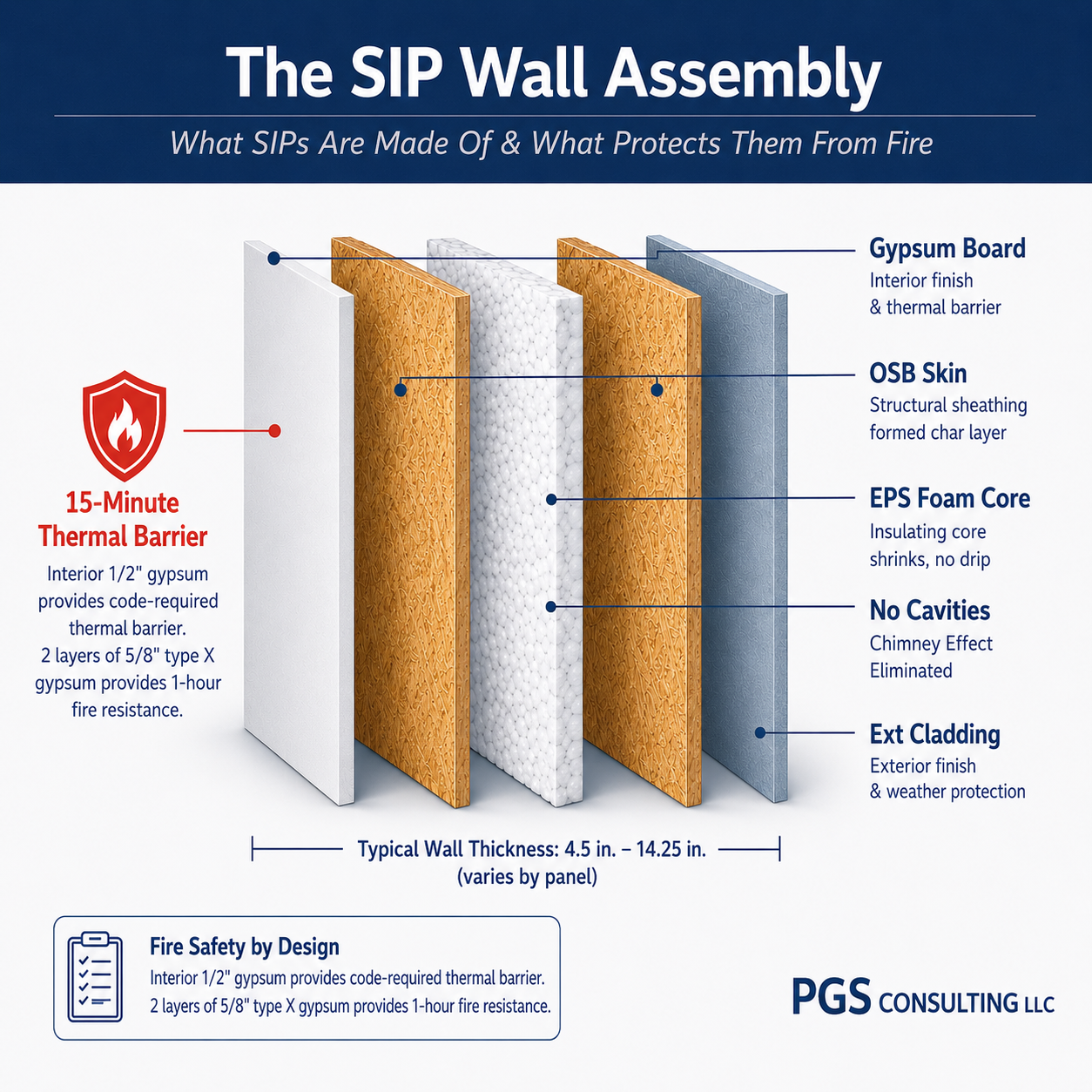
KEY TAKEAWAYS
SIPs are combustible -- both the OSB skins and the foam core will burn when exposed to sufficient heat.
Combustible does not mean unsafe. Fire safety is determined at the assembly level, not the material level.
Building codes require a thermal barrier -- typically 1/2-inch gypsum board -- to protect the foam core and delay heat transfer for a minimum of 15 minutes.
SIPs eliminate the stud-cavity chimney effect found in stick framing, which is a meaningful advantage in a fire.
SIP assemblies are tested to ASTM standards and manufacturers must provide third-party compliance reports like an ICC-ES evaluation report documenting code compliance.
Proper installation is non-negotiable. A correctly installed SIP system with continuous gypsum performs predictably. Shortcuts during installation eliminate that protection.
What "Combustible" Actually Means -- and What It Doesn't
The building code sorts materials into two buckets: combustible and non-combustible.
Foam plastics -- like EPS, GPS, and polyurethane (PUR/PIR) -- are considered combustible. OSB is combustible. So is dimensional lumber. So is virtually every structural material used in standard residential construction.
Here's the thing most people don't realize: the code allows combustible materials in residential buildings all the time. What the code cares about is whether the assembly -- the combination of materials, barriers, and installation details -- meets fire performance requirements.
A combustible material inside a properly protected assembly is not a fire hazard. It's just construction.
How the OSB Skins Behave in Fire
OSB is a wood-based panel, and like all wood, it will ignite and burn. But it doesn't just disappear.
When OSB is exposed to fire, it forms a protective char layer on the surface. That char slows heat transfer into the material behind it. This is the same behavior that makes mass timber construction code-approved, and it's the same reason wood-framed homes have been built safely for over a century.
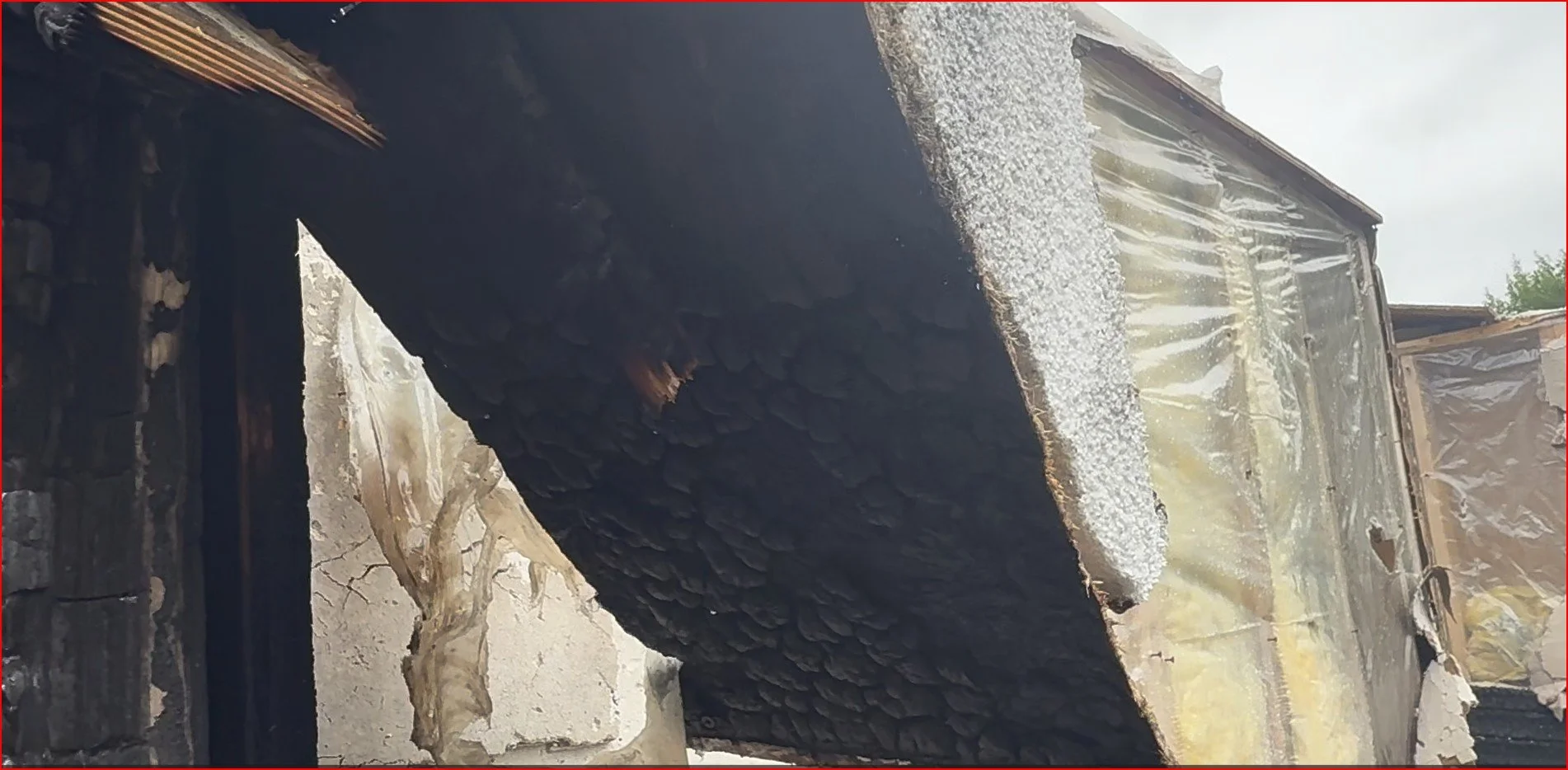
Charred OSB Facer
What OSB does not do:
It does not melt
It does not drip burning material
It does not collapse instantly
OSB's fire behavior is well understood by fire engineers. It's a known, modeled, engineered-for property -- not a wild card.
The takeaway: OSB is combustible, but it burns in a predictable, controlled way that engineers account for in assembly design.
How the Foam Core Behaves in Fire
EPS foam behaves differently than OSB, and it's worth being precise about this.
EPS will ignite when exposed to sufficient heat. Unlike OSB, it does not form a char layer -- it shrinks away from the heat source instead. Construction-grade EPS is treated with a flame retardant, which means it will not sustain an open flame without a continuous external ignition source.
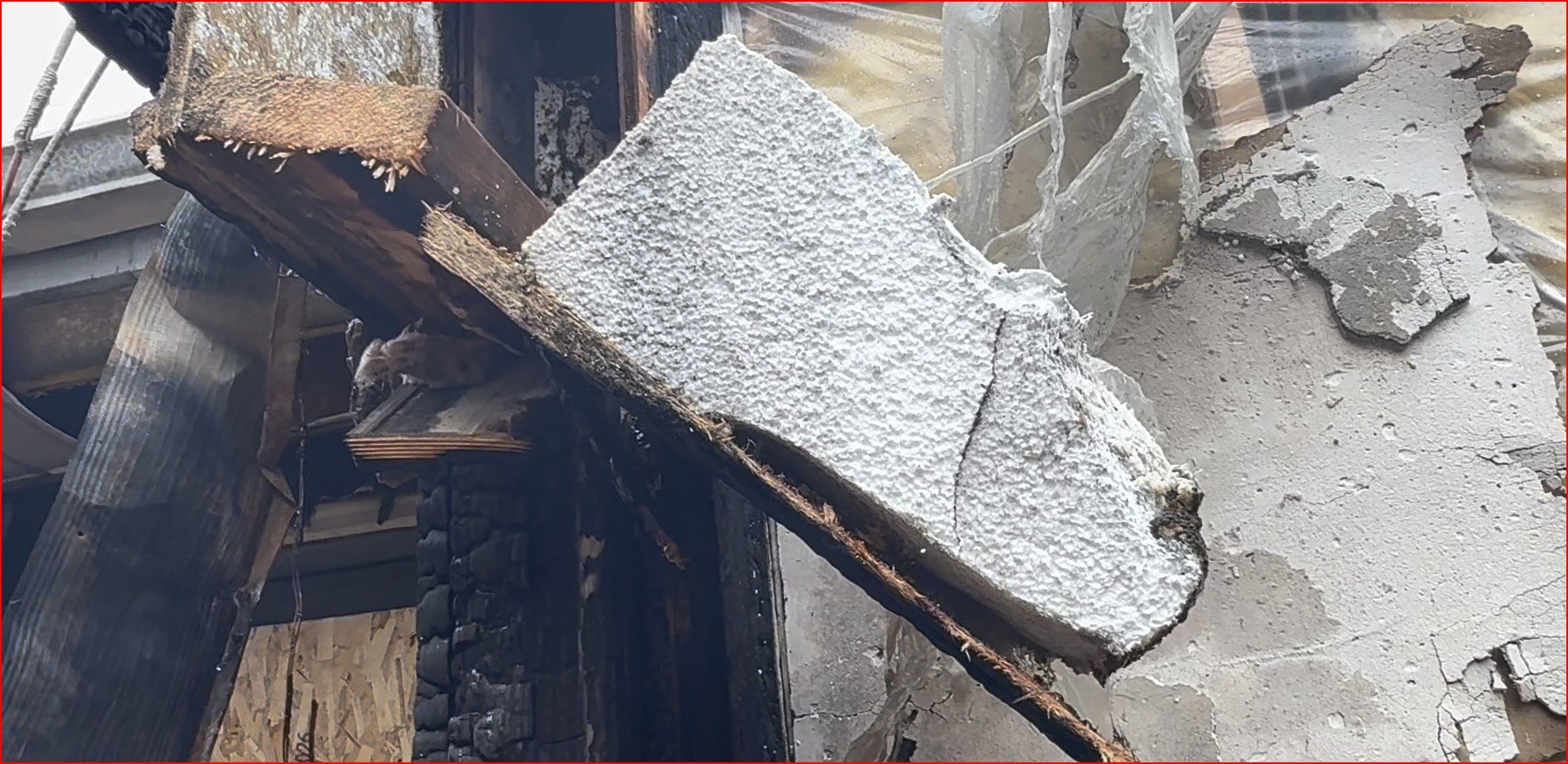
EPS Melt Back
What this means practically: if the gypsum thermal barrier on the interior of a SIP wall is intact and properly installed, the foam core is effectively shielded from heat long enough for occupants to exit and for fire suppression to respond. The foam never has a chance to become the problem.
This is exactly why the building code requires a thermal barrier. It's not a workaround or a patch -- it's the engineered solution.
The takeaway: EPS combustibility is managed through assembly design. The gypsum or an approved thermal barrier is not optional.
What the Building Code Actually Requires
Foam plastics are only permitted in residential construction when protected by a thermal barrier. For SIP walls, that almost always means:
1/2-inch gypsum board on the interior face
Installed continuously, with no gaps
Providing a minimum 15-minute fire-resistance rating
SIP manufacturers test their assemblies to two primary ASTM standards:
ASTM E119 -- tests the fire resistance of building assemblies as a whole
ASTM E84 -- tests surface burning characteristics of individual materials
Both tests produce the data that goes into a third-party authored compliance report like an ICC-ES evaluation report. Those reports are publicly available and document exactly what a manufacturer's panels are approved for, under what conditions, and with what installation requirements.
Enercept, for example, publishes their ICC-ES evaluation report (ESR-4693) on their website. Any SIP manufacturer worth working with has an equivalent document. The SIPA SIP Manufacturing members all have a third-party listing report.
The takeaway: Code compliance for SIPs is not a gray area. The requirements are specific, the testing is standardized, and the documentation is publicly accessible.
Why Gypsum? The Science Behind the Thermal Barrier
Most people know the rule -- SIP walls require gypsum on the interior face. Fewer people know why gypsum specifically, and why that matters.
It's not just about thickness. Gypsum does something most building materials can't: it fights fire with chemistry.
Gypsum board contains water that is chemically bound inside its molecular structure -- not liquid water you can see or feel, but water locked into the material itself at a molecular level. When gypsum is exposed to heat, it releases that bound water as steam. That process absorbs an enormous amount of heat energy acting like a built-in air conditioner that delays heat transfer and keeps the surface behind the gypsum significantly cooler for an extended period of time.
That's what creates the 15-minute thermal barrier rating. It's not just a physical shield sitting between the fire and the foam. It's an active chemical process that consumes heat before that heat can reach the EPS core.
Even after complete calcination, when all the water has been released, the gypsum board continues to act as a heat-insulating barrier. Essentially, the board sacrifices itself to prevent the passage of heat and flame and does so in a sequential manner working back from the heat source. At that point, the material has done its job -- it has bought time. This is exactly why installation quality is non-negotiable. Gaps in the gypsum, missing sections at corners, or improperly taped joints all reduce the total water available to absorb heat. A compromised gypsum installation doesn't just look wrong -- it physically shortens the time the assembly can hold.
This is also why the code specifies continuous installation. Every inch of gypsum on that wall is contributing to the thermal delay. Treat it like the structural component it is.
Why SIPs Don't Have the "Chimney Effect" Problem
This is one of the most important fire performance differences between SIPs and stick framing, and it's often overlooked.
In conventional wood-frame construction, walls and floor assemblies contain open cavities between studs and joists. When a fire starts, those cavities act like chimneys -- they channel air and allow flames to travel vertically through a wall much faster than the surface materials alone would burn.
SIPs eliminate this pathway entirely.
There are no open cavities. The foam core is continuous from one face to the other. The assembly is airtight. There is nowhere for fire to race through.
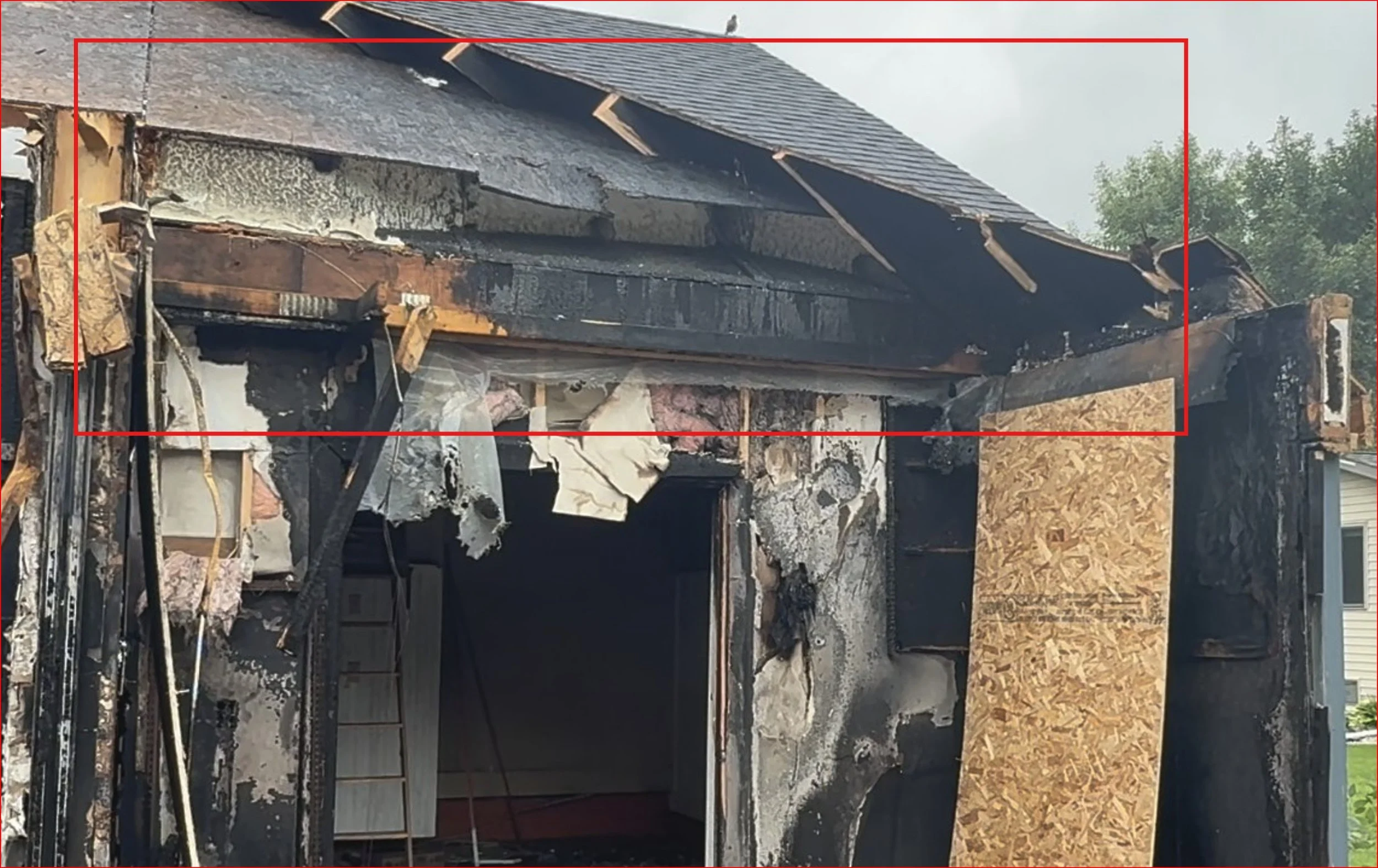
SIP roof panels with melted EPS core and no chase for the fire to travel in (chimney effect).
Real-world evidence backs this up. Enercept documented a residential fire in which the stick-framed roof section collapsed while the SIP walls remained standing. Their explanation aligns with the physics: without stud-bay air channels, vertical fire spread slows dramatically.
The takeaway: The same feature that makes SIPs energy-efficient -- the continuous, airtight core -- also reduces one of the most dangerous fire behaviors in traditional framing.
Fire performance: SIPs vs. stick framing
← Swipe to view full table
| Fire performance factor | SIPs | Stick framing |
|---|---|---|
| Open stud cavities | None Continuous foam core, no air channels |
Present Cavities between every stud bay |
| Chimney effect risk | Eliminated No pathway for vertical fire spread |
Present Stud bays channel heat and flame upward |
| Thermal barrier required | Yes -- gypsum ½ in. gypsum board, interior face |
Yes -- gypsum Same requirement, same material |
| Structural facing behavior | OSB forms a protective char layer; slows heat transfer | Dimensional lumber also chars; similar behavior |
| Core / insulation behavior | EPS shrinks from heat; treated with flame retardant; does not drip | Batt insulation (fiberglass or mineral wool) is typically non-combustible |
| Airtightness advantage | Yes Continuous assembly limits oxygen supply to fire |
No Drafty framing cavities feed combustion |
| Assembly fire-resistance testing | ASTM E119 and ASTM E84; ICC-ES evaluation report required | ASTM E119; code prescriptive compliance path |
| Real-world documented performance | SIP walls have remained standing after adjacent stick-framed sections collapsed (Enercept case study) | Standard residential fire performance; well-documented over decades |
What This Looks Like in a Real Fire
Let's put it together in plain terms.
In a fire scenario where a properly installed SIP home is involved:
The fire encounters the interior gypsum surface first
The gypsum delays heat transfer for at least 15 minutes -- enough time for evacuation
The foam core, protected by the gypsum, does not ignite immediately
Even as heat increases, the EPS shrinks rather than spreading flame
The continuous, airtight wall and roof assembly slows vertical fire spread
The OSB skins eventually char, but that char layer slows further heat penetration
This is predictable, engineered behavior. It's not luck. It's the result of code-tested, ASTM-verified assembly design.
Where things go wrong is when installation is cut short. Gypsum that isn't continuous, panels that aren't properly sealed, or electrical penetrations that aren't correctly detailed can compromise the entire thermal barrier. That's why correct installation isn't just about structural performance -- it directly affects fire safety.
The Bottom Line
SIPs are combustible. So is almost every other material in a wood-framed home.
What makes a building safe in a fire is not whether its materials are combustible -- it's whether the assembly is properly designed, properly tested, and properly installed. On all three of those measures, SIPs hold up well.
The code requirements are clear. The testing standards are established. The performance data exists. When a SIP system is installed correctly, with the required thermal barriers and proper detailing, it behaves predictably in fire -- and in some important ways, better than stick framing.
Have a SIP Project That Needs an Independent Review?
Fire performance questions, code compliance concerns, or structural details that don't quite add up -- these are exactly the situations where an independent engineering review pays for itself. Joe Pasma, PE has 40+ years working directly in SIP engineering, manufacturing, and forensic analysis, including cases where fire performance was the central issue.
Contact Joe Pasma, PE to talk through what your project needs →
Frequently Asked Questions
Are SIPs combustible?
Yes. Both the OSB skins and the foam core are combustible materials. Fire safety is achieved at the assembly level, primarily through continuous gypsum thermal barriers and airtight construction.
Are SIPs safe in a fire?
Yes -- when installed correctly. SIP assemblies are tested to ASTM standards and must meet specific building code requirements for fire resistance. Proper installation of the required thermal barrier is essential.
Does OSB burn?
Yes, OSB is a wood product and will burn. But it forms a protective char layer when exposed to fire, which slows heat transfer and contributes to predictable, engineered fire performance.
Does EPS foam in SIPs burn?
EPS is combustible, but construction-grade EPS is treated with a flame retardant and will not sustain an open flame without a continuous external ignition source. A continuous gypsum thermal barrier is required to protect the foam core in any SIP assembly.
What keeps the foam from igniting in a SIP wall?
A continuously installed 1/2-inch gypsum board on the interior face of the wall. This thermal barrier delays heat transfer for at least 15 minutes, which meets the code-required standard. The foam behind it is also treated with a flame retardant.
Do SIPs burn faster than stick framing?
No -- and in some ways they burn more slowly. SIPs eliminate the open stud cavities found in stick framing, which removes the chimney effect that allows fire to spread rapidly through a conventional wall. Documented fire incidents show SIP walls remaining intact after adjacent stick-framed sections have failed.
Do SIPs meet building code fire requirements?
Yes. SIP manufacturers are required to have their assemblies tested to ASTM standards and must publish third-party compliance reports like an ICC-ES evaluation report documenting compliance with thermal barrier, ignition barrier, and fire-resistance requirements. These reports are publicly available. The SIPA SIP Manufacturing members all have a third-party listing report.
What happens if the gypsum is not installed correctly?
The thermal barrier is the primary fire safety mechanism for foam-core SIP panels. Gaps, missing sections, or improper installation of the gypsum can compromise the entire fire-resistance rating of the wall assembly. Correct installation is not optional -- it is a code requirement.
About the Author
Joe Pasma, PE is a licensed professional engineer and the founder of PGS Consulting LLC in White Bear Lake, Minnesota. He has spent more than 40 years working directly in SIP engineering, manufacturing operations, installation oversight, and forensic analysis. Joe has worked with SIP manufacturers, builders, designers, and legal teams across the country -- including cases involving fire performance, building failures, and code compliance disputes.
He is one of a small number of engineers in the United States with deep, hands-on experience across the full SIP lifecycle. Learn more about Joe Pasma, PE.